SMC Killzones: The Complete Trading Guide — Best Times to Trade Stocks (2026)
Master SMC and ICT killzones in 2026. Learn the Asian, London, and New York session windows, why setups fail outside killzones, the Silver Bullet strategy, and how to build a time-based trading routine for US stocks.
Introduction
You can have the perfect setup. The right order block. A clean fair value gap. A confirmed liquidity sweep. A valid post-BOS inducement level with a lower timeframe CHoCH. Every SMC box checked.
And the trade still fails — not because your analysis was wrong, but because it happened at 2:00 PM on a Tuesday. The market was in its midday dead zone. Nobody with real capital was committed to a direction. The setup that looked institutional was actually retail noise dressed up in institutional clothing.
This is the problem that killzones solve.
Killzones are the specific time windows during each trading day when institutional order flow actually enters the market — when banks, hedge funds, and market makers activate their trading desks, execute their large orders, and create the genuine, directional price delivery that SMC setups are designed to capture.
Outside killzones, price can form patterns that look exactly like institutional setups — order blocks, FVGs, liquidity sweeps — but without the actual institutional participation to back them. The result is setups that look right but fail, producing the confusing experience of technically correct analysis producing losing trades.
Inside killzones, the institutional participation is real. The manipulation sweeps have genuine momentum. The distribution moves have genuine follow-through. The setups work because the volume and intent required for them to work is actually present.
Understanding killzones transforms Smart Money Concepts from a collection of patterns you apply randomly throughout the day into a time-based, institutionally-aligned trading framework where every entry has not just structural logic but temporal logic — the right pattern at the right time.
TL;DR — Key Takeaways
- Killzones are specific time windows when institutional order flow is highest — setups inside them have genuine institutional backing; setups outside them often fail regardless of technical validity
- The four killzones: Asian (8:00–10:00 PM ET), London Open (2:00–5:00 AM ET), New York AM (7:00–11:00 AM ET / 8:30–11:00 AM for US stocks), London Close (10:00 AM–12:00 PM ET)
- The New York AM killzone (8:30–11:00 AM ET) is the highest-probability window for US stock traders — more quality setups occur here than all other windows combined
- The Silver Bullet (10:00–11:00 AM ET) is the single most precise sub-window for US stock day traders
- The midday dead zone (11:30 AM–1:30 PM ET) has significantly lower probability — most trades taken here fail or chop
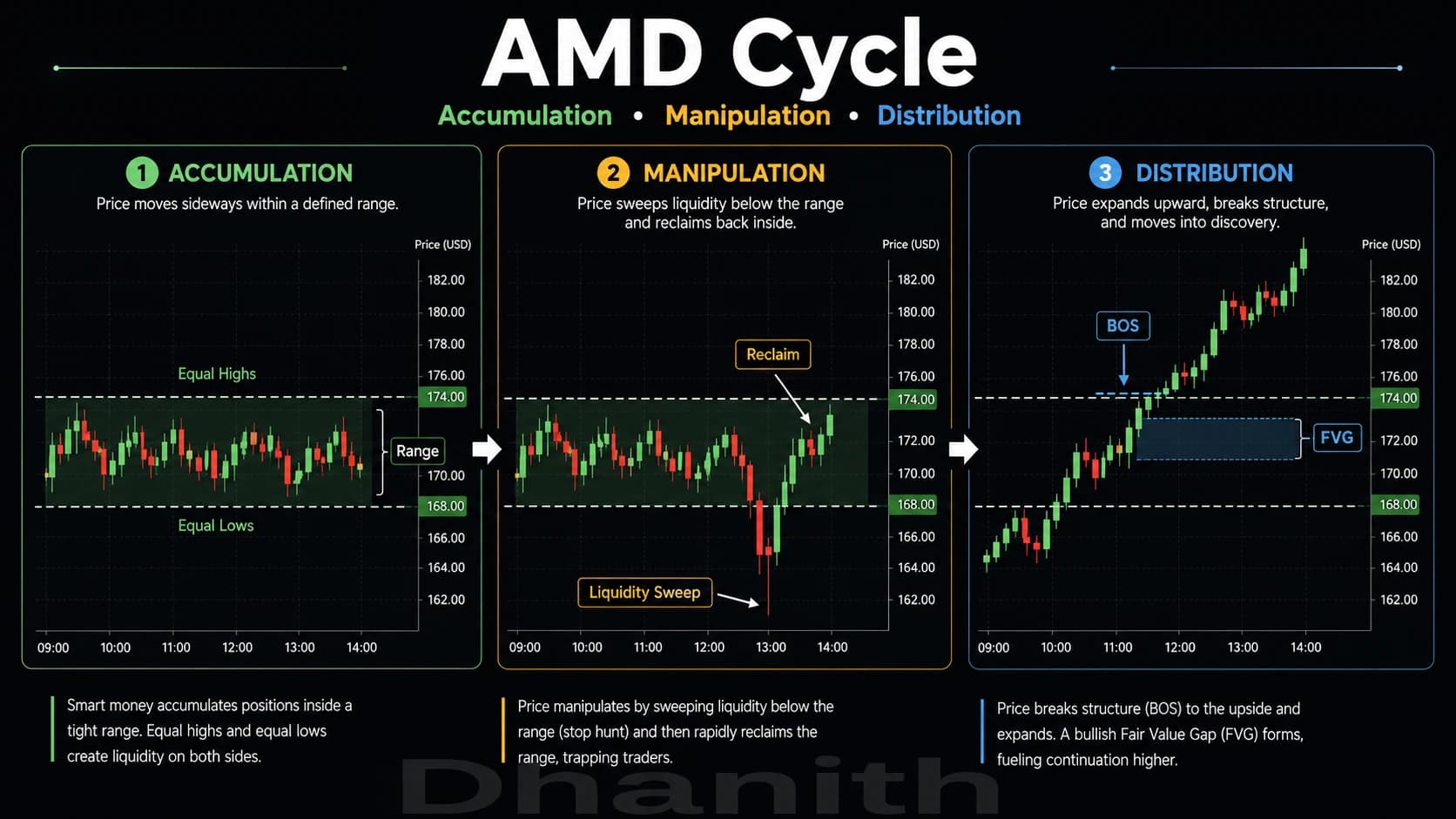
- Killzones align with the AMD cycle: Asian = Accumulation, London = Manipulation (Judas Swing), NY = Distribution
- Trade only setups that form within killzones; setups that form outside must be confirmed by the next killzone before trading
- One quality killzone trade per day beats five mediocre all-day trades every time
Part 1: Why Killzones Exist — The Institutional Logic
Markets Are Not Equally Active 24 Hours a Day
Retail traders imagine financial markets as continuously active — a 24-hour stream of real trading decisions. The reality is more structured: major financial institutions operate on business hours tied to their geographic location.
- London banks (Barclays, HSBC, Deutsche Bank) execute their largest orders during European business hours — primarily 2:00 AM to 5:00 PM ET
- New York institutions (Goldman Sachs, JPMorgan, Citadel) are most active during US business hours — primarily 8:00 AM to 5:00 PM ET
- Asian institutions (Japanese banks, Australian funds) are active during their own business hours — primarily 7:00 PM to 2:00 AM ET
The overlapping periods — when two or more institutional centers are simultaneously active — produce the highest volume, tightest spreads, and most directionally committed price movement. These overlaps define the killzones.
Outside of institutional business hours, volume is dominated by algorithmic systems executing routine orders, smaller regional participants, and retail traders. This thinner volume environment creates choppy, indecisive price action that lacks the directional conviction of genuine institutional delivery.
Why Setups Fail Outside Killzones
A bullish order block forms at 2:00 PM ET (US midday dead zone). Price enters the OB and appears to react. The trader enters long. Price moves up 5–10 points, then reverses and chops sideways for hours, eventually stopping out the position.
The OB was technically valid. The entry was structurally correct. But at 2:00 PM, there were no significant institutional buyers present to defend the OB with genuine buying pressure.
Contrast this with the same OB reacting at 10:00 AM ET (NY AM killzone). Institutional buyers activate, the OB is defended with genuine $100 million+ buy orders, the reaction is sharp and sustained, and the move reaches its target cleanly.
Same pattern. Different time. Opposite result.
The Core Rule: A technically valid SMC setup that forms outside a killzone is a lower-probability trade regardless of how perfect it looks. A technically valid SMC setup that forms within a killzone and is confirmed by institutional volume has maximum probability. Time and structure together create the edge — neither alone is sufficient.
Part 2: The Four Killzones — Complete Breakdown
The Complete Killzone Reference Table
| Killzone | Forex (ET) | US Stocks (ET) | Character | AMD Phase |
|---|---|---|---|---|
| Asian | 8:00 PM–10:00 PM | Pre-market: 4:00–8:00 AM | Range-building, accumulation | Accumulation |
| London Open | 2:00 AM–5:00 AM | Futures: 2:00–5:00 AM | Judas Swing, liquidity grab | Manipulation |
| New York AM | 7:00 AM–10:00 AM | 8:30 AM–11:00 AM | Primary directional delivery | Distribution |
| Silver Bullet | 10:00–11:00 AM | 10:00 AM–11:00 AM | Highest precision sub-window | Peak Distribution |
| London Close | 10:00 AM–12:00 PM | 10:00 AM–12:00 PM | Profit-taking, continuation | Late Distribution |
| Midday Dead Zone | 11:30 AM–1:30 PM | 11:30 AM–1:30 PM | Avoid — low probability | Mini-Accumulation |
| New York PM | 1:30 PM–4:00 PM | 1:30 PM–4:00 PM | Lower quality continuation | Secondary Distribution |

Killzone 1: The Asian Session (Accumulation)
Forex time: 8:00 PM–10:00 PM ET US Stock equivalent: Pre-market (4:00 AM–9:30 AM ET) AMD phase: Accumulation
The Asian session is the market's quiet period — the institutional "loading dock" where positions for the next major session are built. Price action is characteristically tight, range-bound, and low-volatility.
What happens during the Asian session:
- Price consolidates in a narrow horizontal range
- Institutional accumulation occurs quietly, absorbing the available liquidity on both sides of the range
- Equal highs and equal lows form at the range boundaries — marking the liquidity pools that London and NY sessions will target
- The day's high or low is frequently established during the Asian session
For US stock traders: The pre-market session (4:00–9:30 AM ET) functions as the Asian session equivalent. The pre-market range — the high and low established before the regular session opens — marks the accumulation zone and the liquidity targets for the opening Judas Swing.
What to do during this killzone:
- Mark the range: Identify the pre-market high and low as your key levels
- Mark equal highs and equal lows — these are the Judas Swing targets
- Do not trade aggressively: Pre-market volume is thin and directional moves are unreliable
- Prepare your watchlist: Review higher timeframe bias, identify potential OBs and FVGs within range of the pre-market area
The Asian killzone is for preparation, not execution.
Killzone 2: The London Open (Manipulation)
Time: 2:00 AM–5:00 AM ET AMD phase: Manipulation — the Judas Swing
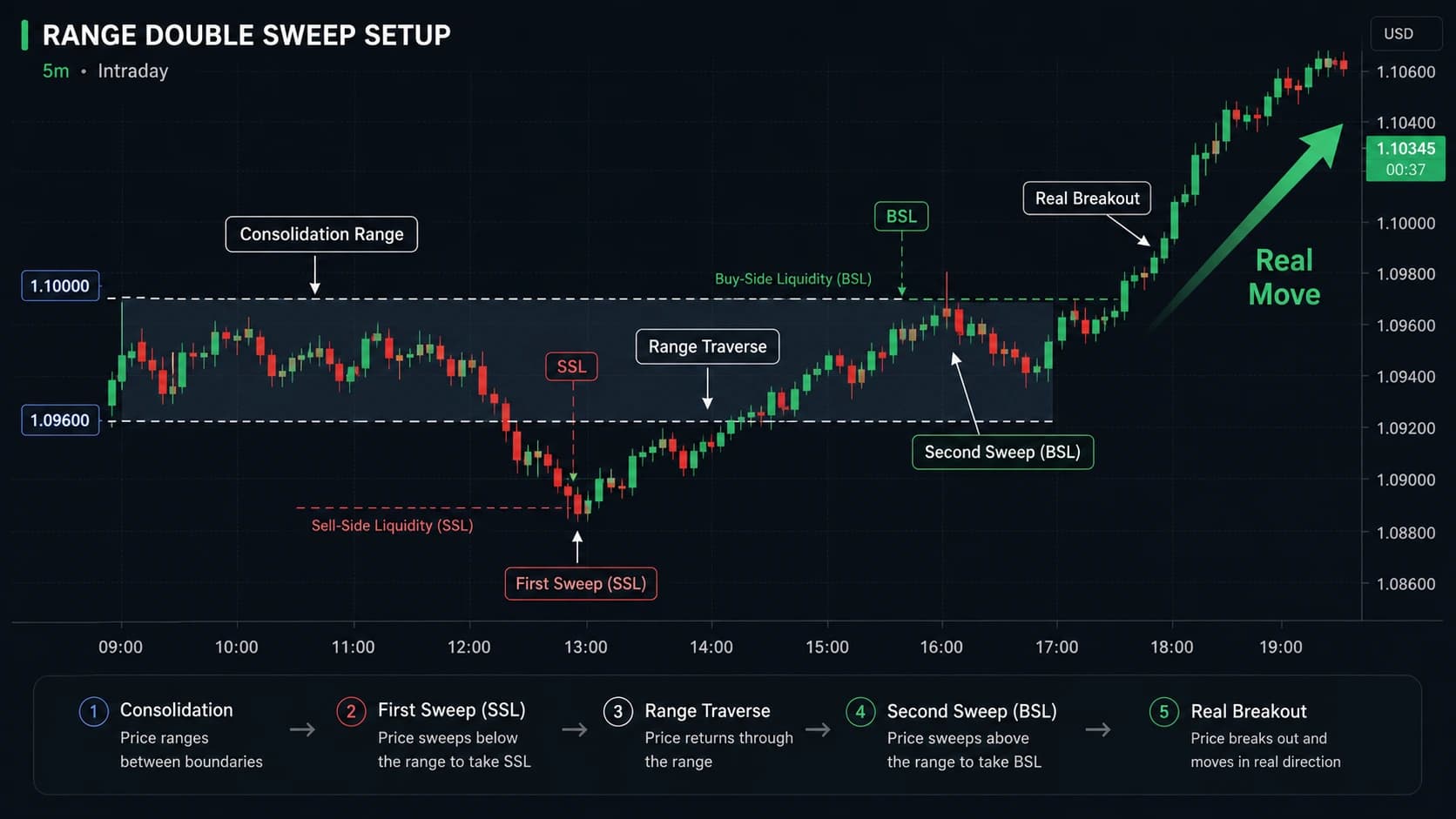
The London Open killzone is the most deceptive period of the trading day. It is where the AMD cycle's manipulation phase executes — where the Judas Swing sweeps the Asian session liquidity before the real directional move begins.
What happens during the London killzone:
- European institutional traders come online, bringing enormous order flow
- Price makes an aggressive move — typically sweeping the Asian session high (for bearish Judas Swing days) or the Asian session low (for bullish Judas Swing days)
- This sweep triggers the stops of Asian session traders and attracts breakout traders in the wrong direction
- Price then reverses sharply, establishing the real directional bias for the day
- The reversal displacement creates fair value gaps and order blocks that serve as the entry zones for the subsequent NY session
The London killzone signal: When the London open sweeps the Asian high and immediately reverses — that is a bearish Judas Swing. The real move of the day is bearish. When London sweeps the Asian low and immediately reverses — bullish Judas Swing. The real move is bullish.
Killzone 3: New York AM — The Primary Trading Window
Forex time: 7:00 AM–10:00 AM ET US Stocks: 8:30 AM–11:00 AM ET AMD phase: Distribution — the real move
The New York AM killzone is where the vast majority of quality SMC setups occur for US stock traders. This is the primary institutional delivery window for equities — the period when the most significant institutional volume enters the market.
The sub-phases of the NY AM killzone:
8:30–9:30 AM ET (Pre-open / News window): US economic data (CPI, NFP, retail sales) is released at 8:30 AM. Institutional algorithms react to data, creating sharp moves that may or may not represent genuine directional delivery. Avoid entries at 8:30 AM on major economic data days.
9:30–10:00 AM ET (The Opening — Judas Swing window): The most manipulative 30 minutes of the US stock trading day. Price typically makes an aggressive move in one direction within the first 15–30 minutes before reversing in the real daily direction. This opening Judas Swing sweeps the pre-market range's high or low.
Do not enter positions during the first 15 minutes of the regular session. Observe, note the direction of the opening spike, identify the sweep of the pre-market level, and wait for the lower timeframe CHoCH to confirm the reversal.
10:00–11:00 AM ET (The Silver Bullet — Peak distribution): After the opening Judas Swing, the real directional move begins. This 60-minute window is the highest-probability trading hour of the entire day for US stocks.

Killzone 4: The Silver Bullet (10:00–11:00 AM ET)
The Silver Bullet is the highest-precision sub-window within the New York AM killzone, identified by ICT as the single most reliable 60-minute trading window of the entire day.
Why 10:00–11:00 AM is special: At 10:00 AM ET, two significant institutional events coincide:
- The New York AM session is at its peak institutional activity
- European (London) institutional desks begin their wind-down — creating a confluence of European and American order flow simultaneously active
This overlap creates the highest concentration of institutional order flow of the trading day.
The Silver Bullet trading model:
- The opening Judas Swing has completed (pre-market level swept, LTF CHoCH confirmed)
- The initial distribution displacement has begun (a bullish or bearish FVG has formed)
- Price briefly retraces into the FVG during the 10:00–11:00 AM window
- Entry at the FVG's CE (50% midpoint)
- Stop beyond the FVG's far edge
- Target: the opposing session liquidity pool
Pro Tip: If you are new to killzone trading, start with this single constraint: only enter trades during the 10:00–11:00 AM ET window, and only if a clear liquidity sweep occurred in the first 30 minutes of the session (9:30–10:00 AM) followed by an LTF CHoCH. This filter alone — applied consistently for 30 trading days — produces dramatic improvement in win rate.
Killzone 5: London Close (10:00 AM–12:00 PM ET)
Time: 10:00 AM–12:00 PM ET AMD phase: Late distribution / Profit-taking
As European institutional desks close their positions for the day, position squaring creates predictable price movements. The London Close is not an initiation window — it is a management window. Use it for taking partial profits on Silver Bullet positions, moving stops to breakeven, and letting remaining positions run through the dead zone.
The Midday Dead Zone — What NOT to Do
Time: 11:30 AM–1:30 PM ET Probability: Significantly below average Action: Avoid all new entries
The midday period is the most dangerous time for retail traders who are staring at charts. Volume collapses after 11:30 AM as institutional desks break for lunch and European markets are fully closed.
Why the dead zone is dangerous:
- Low volume means small orders have outsized price impact — creating false signals
- Retail traders, desperate for activity, take setups that look valid but lack follow-through
- Institutions occasionally engineer brief stop hunts in the dead zone — creating moves that look like Judas Swings but are actually just liquidity raids with no distribution to follow
The midday discipline: Step away from the charts. Review your morning trades. Update your journal. Do not trade the dead zone.

Killzone 6: New York PM Session
Time: 1:30 PM–4:00 PM ET AMD phase: Secondary distribution or late accumulation Quality: Lower than AM, higher than midday
The PM session provides a second daily trading opportunity, though setups are generally lower quality than the AM window.
When the PM session is worth trading:
- The morning produced a strong directional move that has not yet reached its target
- A meaningful news event (Fed announcement, earnings) occurs after 1:30 PM
- The daily structure is exceptionally clear and the setup is Grade A with all killzone filters confirmed
When to skip the PM session:
- The morning session was choppy with no clean setup
- You have already taken a morning trade
- You are attempting to recover a morning loss — the PM session is not where losses are recovered
Part 3: Killzones and Every SMC Concept — The Integration
Killzones and the AMD Cycle
The AMD cycle and killzones are the same framework described in two languages:
| AMD Phase | Killzone | Session |
|---|---|---|
| Accumulation | Asian | Pre-market for US stocks |
| Manipulation | London Open | Overnight futures for US stocks |
| Distribution | New York AM | Regular session for US stocks |
AMD tells you what institutions are doing. Killzones tell you when they're doing it.
The key integration insight: The Judas Swing (AMD manipulation phase) is most reliable when it occurs at the London open killzone or the NY open's first 30 minutes. A Judas Swing that occurs in the middle of the dead zone is likely retail noise, not genuine institutional manipulation.

Killzones and Order Blocks
Order blocks formed during a killzone carry more institutional significance than OBs formed outside.
A bullish OB that formed at 9:45 AM during the NY AM killzone — as the Judas Swing completed and the first distribution candle displaced upward — is an institutionally-backed zone. A bullish OB that formed at 1:00 PM during the dead zone lacks this temporal validation.
The OB quality filter with killzones: OBs formed during killzones receive a +1 bonus on the 5-point grading scale. OBs formed during the dead zone receive a -1 penalty.
Killzones and Fair Value Gaps
FVGs created during killzone displacement carry maximum institutional significance. FVGs created during dead zone volatility are less reliable. Always note the time that an FVG was created — if it was created during a killzone's primary displacement, treat it as high-confidence. If created during the dead zone or pre-market, downgrade its confidence level.
Killzones and Liquidity Sweeps
Every high-probability liquidity sweep occurs during a killzone. Sweeps that occur outside killzones — especially during the dead zone — are frequently false signals that will not produce the expected reversal.
The sweep timing filter: After identifying a potential liquidity sweep, check the time. Is it during a killzone? If yes — high probability. If no — significantly lower probability, wait for the next killzone to confirm.
Killzones and Market Structure
Market structure BOS and CHoCH signals that occur during killzones are significantly more reliable than those occurring outside them. A 15-minute bullish CHoCH at 9:50 AM — within the NY AM killzone, after a confirmed Judas Swing sweep — is a high-conviction signal. The same CHoCH at 1:30 PM in the dead zone is weak and unreliable.
Part 4: Building a Killzone-Based Trading Routine for US Stocks
The Complete Daily Schedule
6:30–8:30 AM ET — Pre-Session Analysis:
- Review the daily chart: bullish or bearish structure? Premium or discount zone?
- Note what the overnight futures did during the London killzone (which direction was swept)
- Mark the pre-market high and low — these are your Judas Swing targets
- Set price alerts at the pre-market high and low for each watchlist stock
8:30–9:30 AM ET — Pre-Open Window:
- If major economic data released at 8:30 AM, note the reaction but do not trade the spike
- Continue marking key levels. Finalize bias for each instrument
9:30–10:00 AM ET — The Opening (Observe Only):
- Watch the open without entering
- Note which direction price moves first — toward the pre-market high (potential bullish Judas Swing, real move bearish) or pre-market low (potential bearish Judas Swing, real move bullish)
- Watch for the sweep of one pre-market level and the beginning of a reversal
10:00–11:00 AM ET — Silver Bullet Window (Primary Entry):
- After the opening Judas Swing confirms and the LTF CHoCH appears, enter at the FVG's CE or the OB's midpoint
- One trade. Executed with confidence. Maximum position size within your risk parameters
10:00–11:30 AM ET — Trade Management:
- Manage per your pre-defined plan: partial exit at 1:1, stop to breakeven, let remainder run to target
11:30 AM–1:30 PM ET — Mandatory Break:
- Step away from the charts. Non-negotiable.
1:30–3:00 PM ET — PM Session (Optional / Selective):
- Return to charts only if the morning produced no qualifying setup or a major PM news event is producing genuine institutional flow
4:00–5:00 PM ET — End of Day Review:
- Complete journal entry for every setup observed (taken or not taken)
- Mark any new OBs or FVGs formed during the day for tomorrow's setups

Part 5: Common Killzone Mistakes and Exact Fixes
Mistake 1 — Trading All Day Instead of Just Killzones
The most expensive habit in retail trading: staring at charts for 8 hours, forcing trades during the dead zone, taking 5–10 low-quality trades when 1 killzone trade would have produced better results.
The fix: Create a hard stop time for new entries. If you are a Silver Bullet trader, set a rule: no new entries after 11:00 AM ET. Write these rules in your trading plan and enforce them like risk management rules — non-negotiable.
Mistake 2 — Entering During the Opening 15 Minutes
The first 15 minutes of the US stock session (9:30–9:45 AM ET) are the most manipulative of the day. Retail traders enter on the first candle's direction, immediately get reversed by the Judas Swing, and take an early loss.
The fix: The first 15 minutes are observation only. No entries. Watch which direction price spikes. Watch for the sweep. Watch for the reversal beginning. The entry comes after this sequence completes — not during it.
Mistake 3 — Treating All Killzones Equally
Attempting to trade the Asian killzone with the same aggression as the Silver Bullet, or trading the London killzone (2–5 AM) as a US equity trader when most US stocks haven't even opened yet.
The fix: Each killzone has a specific role. Asian = preparation. London = overnight futures bias for US traders, not US stock execution. NY AM = your primary execution window. London Close = trade management, not initiation.
Mistake 4 — Ignoring Economic Calendar
Major economic data releases (CPI, PPI, NFP, Fed decisions) distort killzone patterns, extend or compress the Judas Swing, and produce false SMC signals.
The fix: Check the economic calendar every morning before the session. On major data days, either wait for the post-data volatility to settle (30–60 minutes after the release) before looking for setups, or skip the day entirely.
Mistake 5 — Chasing Price After the Killzone Ends
The Silver Bullet produces a clean entry at 10:15 AM. The trade runs to 3R profit by 11:00 AM. The trader exits, then tries to re-enter at 11:45 AM in the dead zone to "capture more of the move."
The fix: When the killzone ends, the institutional flow that drove the setup ends with it. Re-entries in the dead zone are low-probability by definition. Accept the profit from the killzone trade.
Mistake 6 — Trading the PM Session After a Morning Loss
Taking a loss in the Silver Bullet window and then aggressively trading the PM session to "make it back."
The fix: A morning loss is information — either the daily bias was wrong or the setup did not meet full criteria. Accept the loss, journal the morning, and return fresh tomorrow with the next killzone.
FAQ
Q: What are SMC killzones in trading? SMC killzones are specific time windows during each trading day when institutional order flow — from banks, hedge funds, and market makers — is highest. Setups that form during killzones have genuine institutional backing and typically produce clean, predictable price delivery. Setups that form outside killzones lack this institutional participation and fail significantly more often. The four main killzones are the Asian (pre-market for US stocks), London Open, New York AM, and London Close.
Q: What is the best killzone for US stock traders? The New York AM killzone (8:30–11:00 AM ET for US stocks) is the highest-probability window, with the Silver Bullet sub-window (10:00–11:00 AM ET) being the single most reliable 60-minute period of the day. More quality SMC setups occur during the NY AM killzone than all other sessions combined for US equities.
Q: What is the Silver Bullet in ICT trading? The Silver Bullet is the 10:00–11:00 AM ET sub-window within the New York AM killzone. It coincides with the peak of NY institutional activity and the wind-down of London institutional flow, creating a confluence of European and American order flow. The Silver Bullet setup combines a post-Judas-Swing FVG or OB retracement with this peak-volume window for maximum probability entries.
Q: What is the dead zone in trading? The dead zone refers to the midday US session (approximately 11:30 AM–1:30 PM ET) when institutional volume drops dramatically. Price action becomes choppy, and directional moves lack follow-through. Most SMC setups that form during the dead zone fail because the institutional participation required to sustain them is absent.
Q: How do killzones connect to the AMD cycle? Killzones and the AMD cycle are the same framework expressed differently. The Asian killzone corresponds to the Accumulation phase, the London Open killzone corresponds to the Manipulation phase (Judas Swing), and the New York AM killzone corresponds to the Distribution phase. AMD tells you what institutions are doing; killzones tell you when.
Q: Should I trade every killzone every day? No. Quality over quantity is the core killzone principle. Experienced ICT traders often focus exclusively on the Silver Bullet window (10:00–11:00 AM ET) and skip all other killzones. If the Silver Bullet window does not produce a setup that meets all criteria, the professional response is to take no trade that day.
Conclusion
Killzones are the missing piece that transforms technically correct SMC analysis into consistently profitable trading.
Without killzone awareness, you are applying institutional patterns to non-institutional time periods — getting the structure right but the timing wrong.
Three principles to implement immediately:
1. Only enter during killzones. Not before. Not after. Not during the dead zone. The killzone is the minimum requirement for every trade entry — as non-negotiable as the stop loss.
2. The Silver Bullet is your primary window. One hour. One setup. Maximum preparation. Maximum patience. The 10:00–11:00 AM ET window is where the best trade of your day lives.
3. Step away during the dead zone. Always. The dead zone is not a trading period — it is a journaling, analysis, and rest period.
Related Articles
- Smart Money Concepts: The Complete Mastery Guide — The complete SMC framework that places killzones within the broader institutional trading system
- Accumulation, Manipulation, Distribution (AMD Cycle) — The AMD cycle and killzones describe the same institutional behavior — AMD tells you what, killzones tell you when
- Liquidity Sweeps: The Complete Mastery Guide — High-probability liquidity sweeps only occur during killzones — learn the full mechanics of stop collection
- Order Blocks: The Complete Mastery Guide — Order blocks formed during killzones carry maximum institutional significance — time and structure together create the edge
- Fair Value Gaps: The Complete Mastery Guide — The Silver Bullet setup is built around FVG entries during the 10:00–11:00 AM window
- Inducement (IDM): The Complete SMC Guide — Inducement sweeps are most aggressive during the opening 30 minutes — killzone timing helps you avoid being trapped
Disclaimer: This article is for educational purposes only and does not constitute financial or investment advice. Stock trading involves significant risk of loss. Past performance does not guarantee future results. Always use proper risk management and only trade with capital you can afford to lose.
Continue Reading