Fair Value Gaps (FVG): The Complete Mastery Guide for Stock Traders (2026)
Master fair value gap trading in 2026. Learn how FVGs form, every type explained (IFVG, CE, implied FVG), 5 proven strategies, grading systems, entry models, and common mistakes — with step-by-step stock trading examples.
Introduction
There is a moment every serious price action trader remembers.
You're watching a stock pull back after a sharp rally. It drops steadily, one candle at a time. Then it reaches a specific price zone — a zone you might have previously dismissed as random air between candles — and something changes. Volume appears. A rejection candle forms. Price reverses sharply and continues upward, leaving behind a trade entry that in hindsight looks almost too clean.
That zone was a Fair Value Gap (FVG). And what you witnessed was the market returning to fill a price imbalance left behind by institutional order flow — exactly as predictable and repeatable as gravity.
Fair value gaps are not a niche Smart Money Concepts concept. They are one of the most statistically robust patterns in all of modern price action trading. Research across thousands of setups consistently shows that properly identified FVGs — aligned with trend, formed by genuine displacement, in the correct premium or discount zone — fill and react at rates of 60–75%, with high-grade confluence setups pushing toward the upper end of that range.
But "fill rate" is only half the story. Most retail traders who attempt FVG trading get inconsistent results because they're trading the concept incorrectly: entering the moment price touches a gap (before any confirmation), trading FVGs against the trend, confusing news-driven gaps with institutional FVGs, or not understanding the critical nuances — the Consequent Encroachment, the Inverse FVG, the implied FVG, and the FVG grading criteria that separate high-probability setups from noise.
This guide covers everything. Every type of FVG. The institutional mechanics behind why they form and why they fill. Five distinct trading strategies, from basic to advanced. A complete grading framework. Entry, stop, and target rules. Multi-timeframe application for stock traders. And the most common mistakes with exact, actionable fixes.
By the end, you will understand fair value gaps more completely than the vast majority of SMC traders — and have a complete, rules-based FVG system ready to apply to stocks starting Monday.
TL;DR — Key Takeaways
- A Fair Value Gap is a three-candle price imbalance where candle 1's wick and candle 3's wick do not overlap — the gap between them was created by aggressive institutional order flow
- FVGs fill approximately 70–75% of the time; with proper confluence filters, high-grade setups achieve 60%+ win rates on live data
- The Consequent Encroachment (CE) — the 50% midpoint of the FVG — is the highest-probability entry level; price frequently reacts at CE rather than requiring full gap fill
- An Inverse FVG (IFVG) forms when price violates a standard FVG — the broken zone then flips polarity and acts in the opposite direction
- The five FVG strategies range from basic retracement entries to advanced OB+FVG confluence, IFVG reversals, and multi-timeframe cascade setups
- Valid FVGs require: genuine displacement (not news gaps), alignment with higher timeframe trend, premium/discount positioning, and ideally overlap with an order block
- Stop loss goes just beyond the far edge of the FVG — never in the middle of the gap
Part 1: What Is a Fair Value Gap? The Complete Institutional Explanation
The Three-Candle Pattern
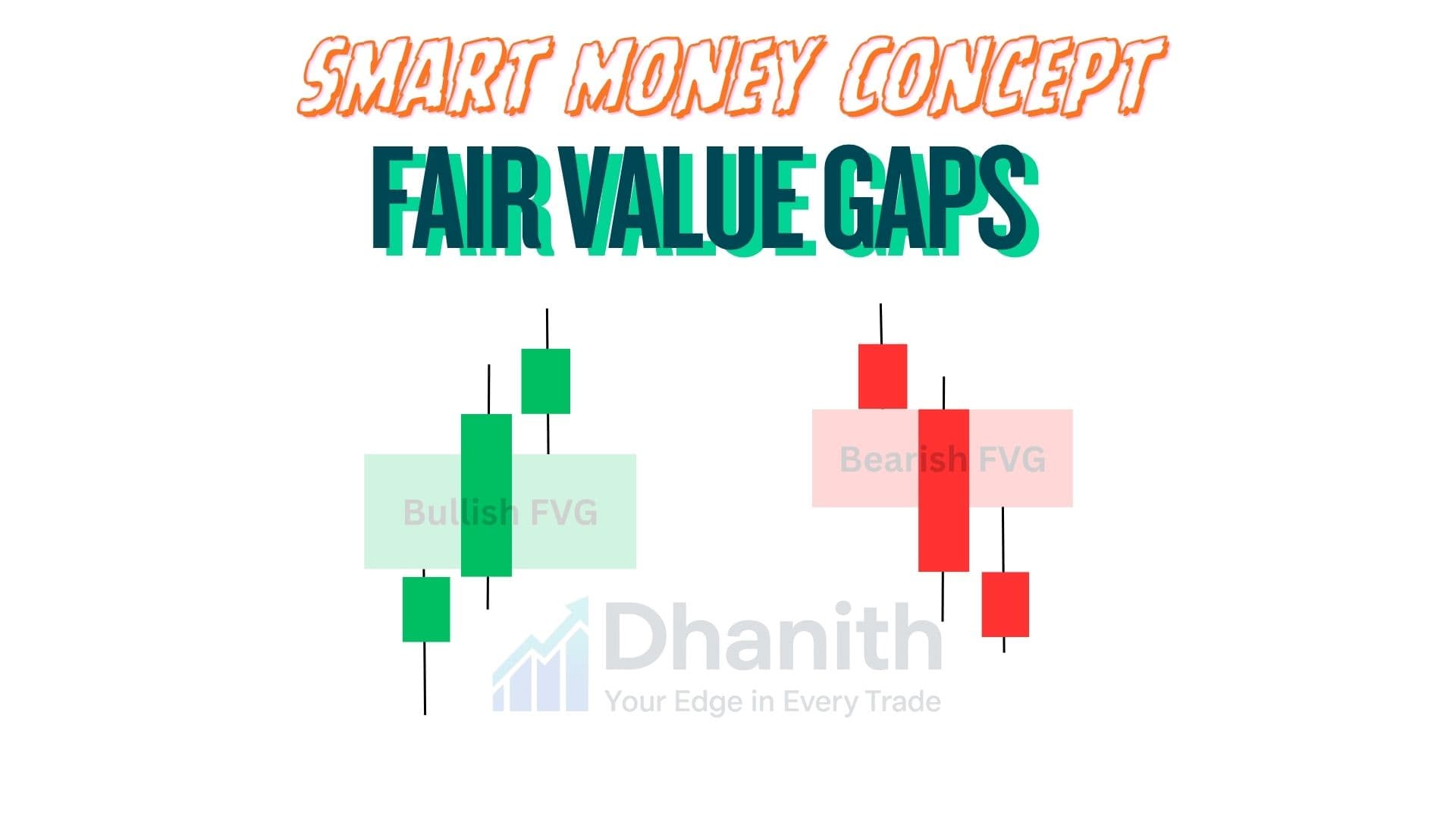
At the most basic technical level, a Fair Value Gap (FVG) is defined by three consecutive candles on any timeframe where the outer wicks of candles 1 and 3 do not overlap.
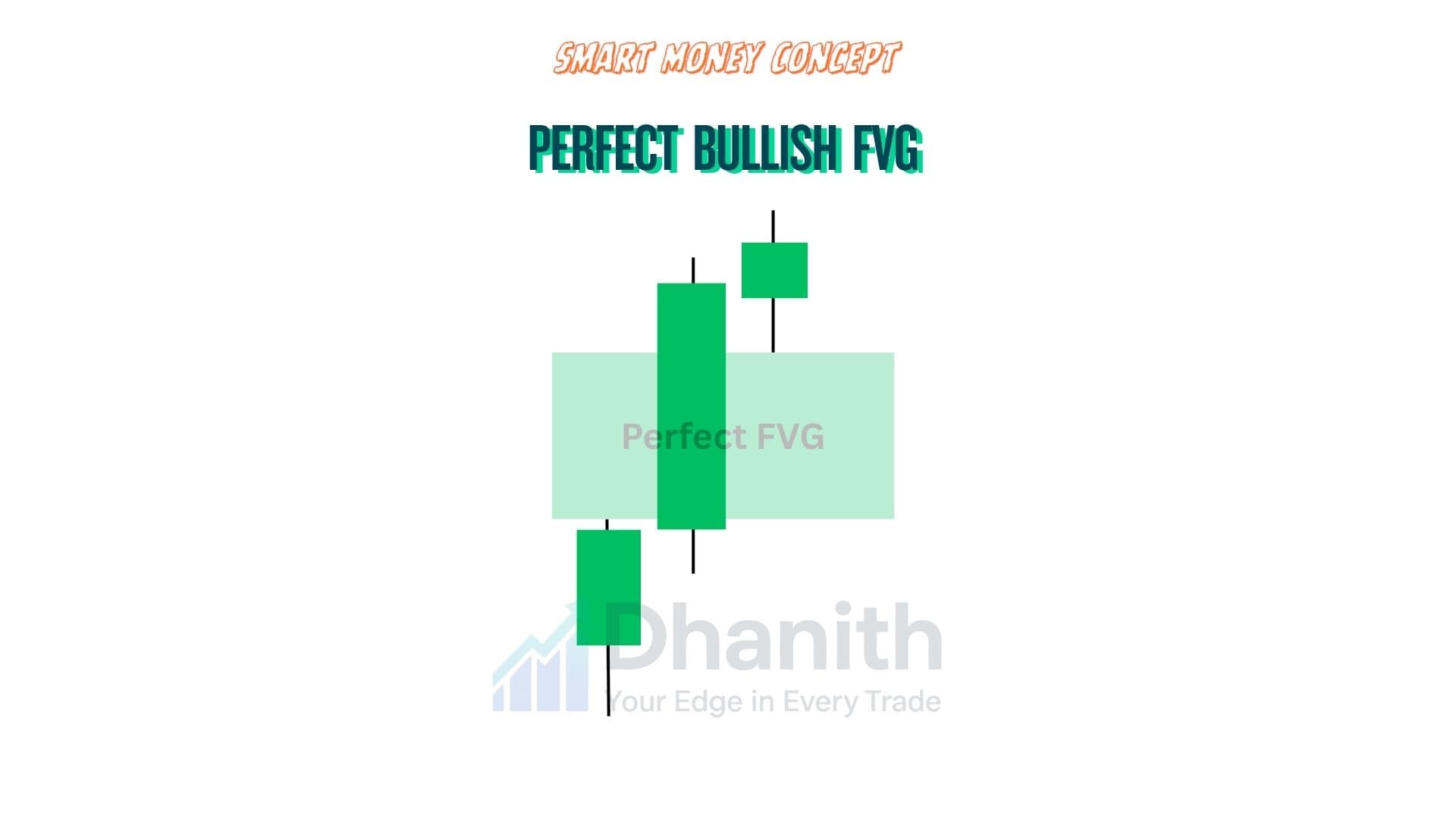
Bullish FVG: The high of candle 1 is lower than the low of candle 3. The space between candle 1's high and candle 3's low is the FVG — an area price skipped entirely on the way up.
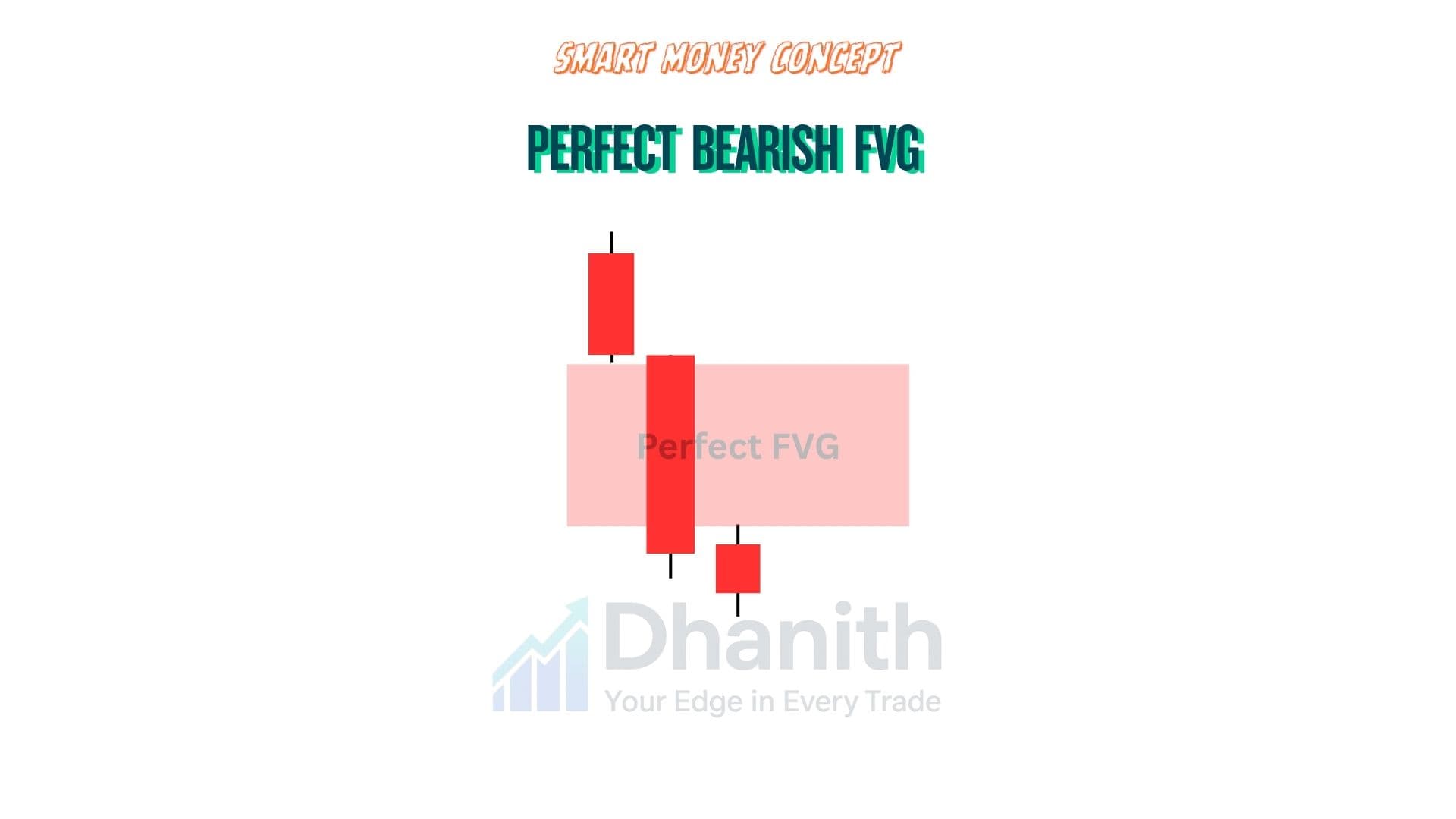
Bearish FVG: The low of candle 1 is higher than the high of candle 3. The space between candle 1's low and candle 3's high is the FVG — an area price skipped entirely on the way down.
Candle 2 in both cases is the displacement candle — the large, aggressive middle candle that moves with such force it creates the gap. The FVG itself is not the displacement candle — it is the unfilled space between the surrounding candles that the displacement candle skipped over.
This distinction matters: many traders mistakenly mark the displacement candle as the FVG. The FVG is the space. Not the candle.
The Institutional Mechanics — Why FVGs Form
To truly understand FVGs, you need to understand the institutional process that creates them.
When a major institution — a fund manager, a bank's proprietary trading desk, or an algorithmic system executing a multi-hundred-million-dollar order — needs to move a significant quantity of a stock, it faces a fundamental challenge: price impact.
Every buy order pushes price upward. Every sell order pushes it down. For large institutions, this impact is not negligible — it can cost millions in slippage if orders are not executed carefully.
Here is the sequence that creates a fair value gap:
Step 1 — Position building: The institution has identified a stock it wants to accumulate. It has been quietly absorbing available sell orders at or near an order block zone, building its position patiently over hours or days.
Step 2 — Liquidity exhaustion: The available sell-side liquidity at the accumulation zone begins to run out. The institution needs to continue filling its order but there are no longer enough opposing orders at current prices.
Step 3 — Aggressive delivery: To continue filling its order at favorable prices, the institution pushes price aggressively upward — essentially moving the market to find the sell orders it needs at higher price levels. This aggressive push creates a large displacement candle.
Step 4 — The FVG is born: The displacement move is so fast and one-sided that it skips certain price levels entirely. The market moves from the bottom of candle 1's high to the top of candle 3's low without any trading activity occurring in between. That untraded zone is the Fair Value Gap — a price area where no legitimate two-sided price discovery occurred.
Step 5 — The market seeks efficiency: Markets are continuous auction systems. The purpose of price is to find fair value — a level where buyers and sellers agree to transact. When price skips a zone entirely, that zone represents an "unfair" area — one where the market never established true two-sided agreement. The market's structural tendency toward price efficiency means it will eventually return to that zone to establish proper price discovery.
This return is the FVG fill — and it is why FVGs are predictive rather than merely descriptive.
Why FVGs Fill: The Three Mechanisms
FVGs fill for three distinct and complementary reasons, each reinforcing the other:
Mechanism 1 — Institutional Order Completion: The institution that created the FVG often has remaining orders at those price levels. When price returns to the FVG zone, the institution uses that return to fill its remaining position at the original favorable price — adding to its holdings on the retracement. This institutional buying (for bullish FVGs) or selling (for bearish FVGs) creates the reaction that traders identify as the FVG "holding."
Mechanism 2 — Price Efficiency: Markets continuously search for price levels where both buyers and sellers are willing to transact. An FVG zone, having been skipped, contains no historical trading activity — no agreed-upon fair value. The market's algorithmic price discovery process gravitates toward these zones to establish genuine two-sided trading.
Mechanism 3 — Algorithmic Programming: In 2026's market environment, a significant percentage of daily stock volume is driven by algorithmic trading systems. Many of these algorithms are explicitly programmed to identify price imbalances — gaps between candle wicks — and position accordingly, expecting a return to those zones. This creates a self-reinforcing dynamic: the more institutional algorithms target FVG zones, the more reliably those zones produce reactions.
Pro Tip: Understanding WHY FVGs fill changes how you trade them. You're not pattern matching — you're reading institutional order flow. When price returns to a bullish FVG and you see a high-volume rejection candle, you're watching the same institution that created the FVG defend its position and add to it. You are trading with that institution — not against it.
FVGs vs. Traditional Chart Gaps
One of the most common misconceptions beginners have is confusing SMC fair value gaps with traditional chart gaps — the open-to-close price jumps that occur between trading sessions when significant news or earnings announcements move a stock price overnight.
Traditional chart gaps (overnight/news gaps):
- Occur between market sessions (close of one day to open of the next)
- Driven by news, earnings, macro events — not institutional order flow strategy
- Fill rate varies wildly depending on gap type (exhaustion, runaway, breakaway)
- Visible as a literal price gap on a daily chart — no candle body at that price level
SMC Fair Value Gaps:
- Occur within any timeframe, during active trading — no overnight gap required
- Driven by aggressive institutional order execution — deliberate, strategic
- Defined by the three-candle wick structure — not a visible gap between session prices
- Fill at ~70–75% rates with specific institutional pattern characteristics
The distinction is critical. A stock that gaps up 5% at the open on earnings — creating a blank space on the chart — is a traditional gap with inconsistent fill behavior. A stock that makes an aggressive intraday move with the three-candle FVG structure during the New York AM session — where candle 1's high and candle 3's low don't overlap — is an SMC FVG with institutional backing and predictable fill behavior.
The rule: If the FVG was created by a news event rather than by identifiable institutional accumulation/distribution within a structural context, treat it with significantly lower confidence.
Part 2: Every Type of Fair Value Gap — The Complete Classification
Type 1: Bullish Fair Value Gap
A bullish FVG forms during an upward displacement move. The three-candle structure creates a zone below the displacement candle where price did not trade — a bullish imbalance.
Formation conditions:
- Candle 1: Any candle in the context of a move
- Candle 2 (displacement): A large, aggressive bullish candle — the "gap candle"
- Candle 3: A candle whose low is higher than candle 1's high
- The space between candle 1's high and candle 3's low = the bullish FVG
How it behaves: When price retraces downward after the bullish impulse and enters the bullish FVG zone, institutional buyers defend the imbalance. The FVG acts as support. The expected reaction is a reversal upward — continuing the bullish move that created the FVG.
Validity requirements:
- The FVG must be formed by displacement — a large, purposeful displacement candle, not routine volatility
- The overall move context must include a Break of Structure (BOS)
- Higher timeframe trend must be bullish
Type 2: Bearish Fair Value Gap
A bearish FVG is the mirror image — formed during a downward displacement move, creating a zone above the displacement candle where price did not trade.
Formation conditions:
- Candle 3's high is lower than candle 1's low
- The space between candle 1's low and candle 3's high = the bearish FVG
How it behaves: When price rallies upward after the bearish impulse and enters the bearish FVG zone, institutional sellers defend the imbalance. The FVG acts as resistance. The expected reaction is a reversal downward.
Type 3: Consequent Encroachment (CE) — The 50% Level
The Consequent Encroachment (CE) is not a separate FVG type — it is the most important level within any FVG.
The CE is simply the 50% midpoint of any fair value gap. It is identified by:
- Measuring the full FVG range (from candle 1's edge wick to candle 3's edge wick)
- Finding the exact midpoint of that range
- Marking it as a horizontal level within the FVG zone
Why the CE matters: In a strong trend, price frequently retraces only to the CE level before reversing and continuing in the original direction. It does not always fill the entire FVG. Traders who wait for full gap fill often miss the entry entirely — or enter late, with a worse risk-reward ratio.
The CE is the highest-probability single level within any FVG. It represents the market's "halfway point" of the imbalance — far enough into the gap to attract institutional interest, but not so deep that the gap is fully mitigated.
Pro Tip: Identify the CE of every FVG you mark. Place a horizontal line at the 50% level of the gap. This single habit transforms FVG trading from a wide-zone concept into a precise entry tool. In strong trends, CE reactions often offer 3:1+ risk-reward because the stop is tight and the continuation is swift.
Type 4: Inverse Fair Value Gap (IFVG)
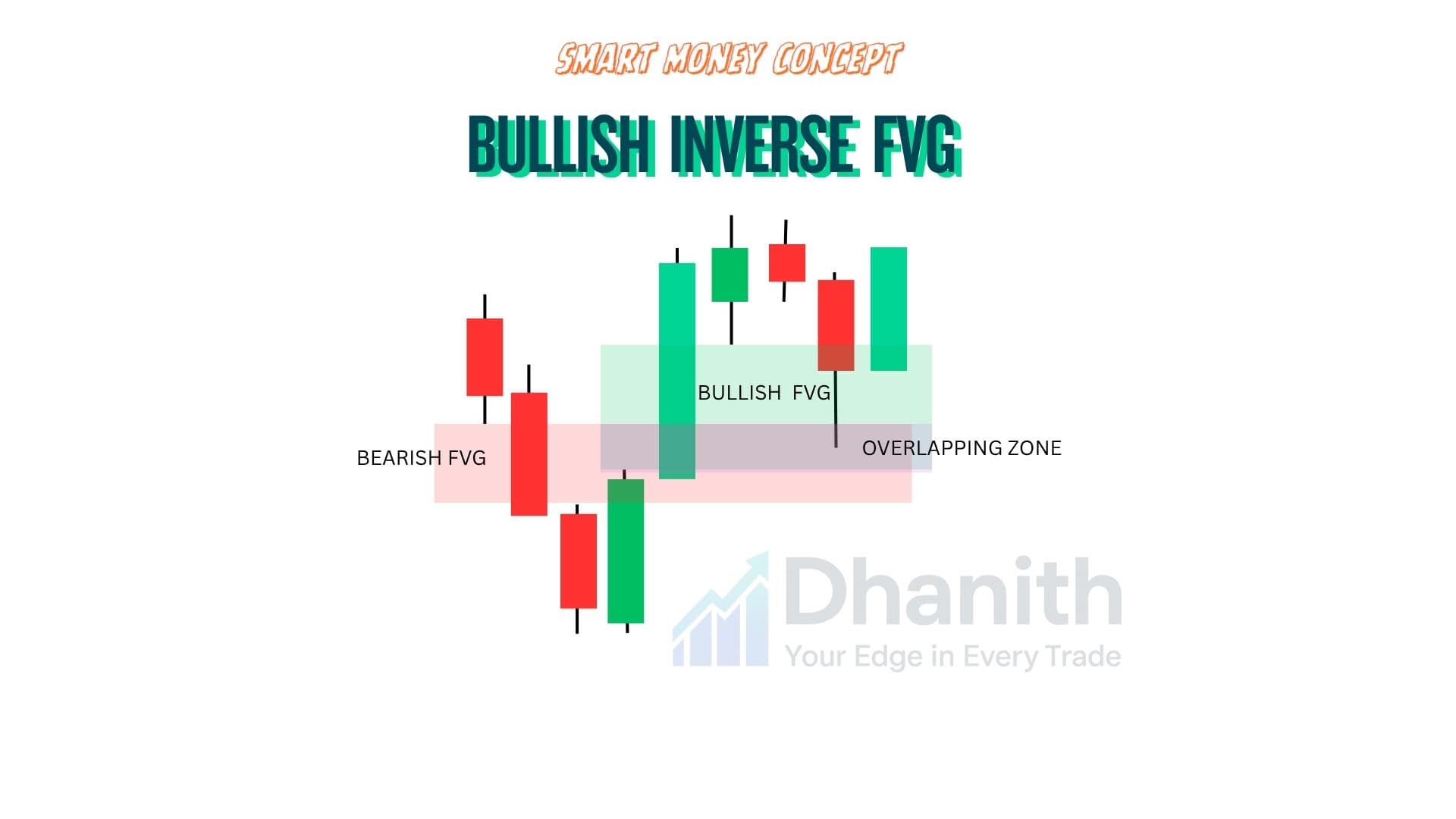
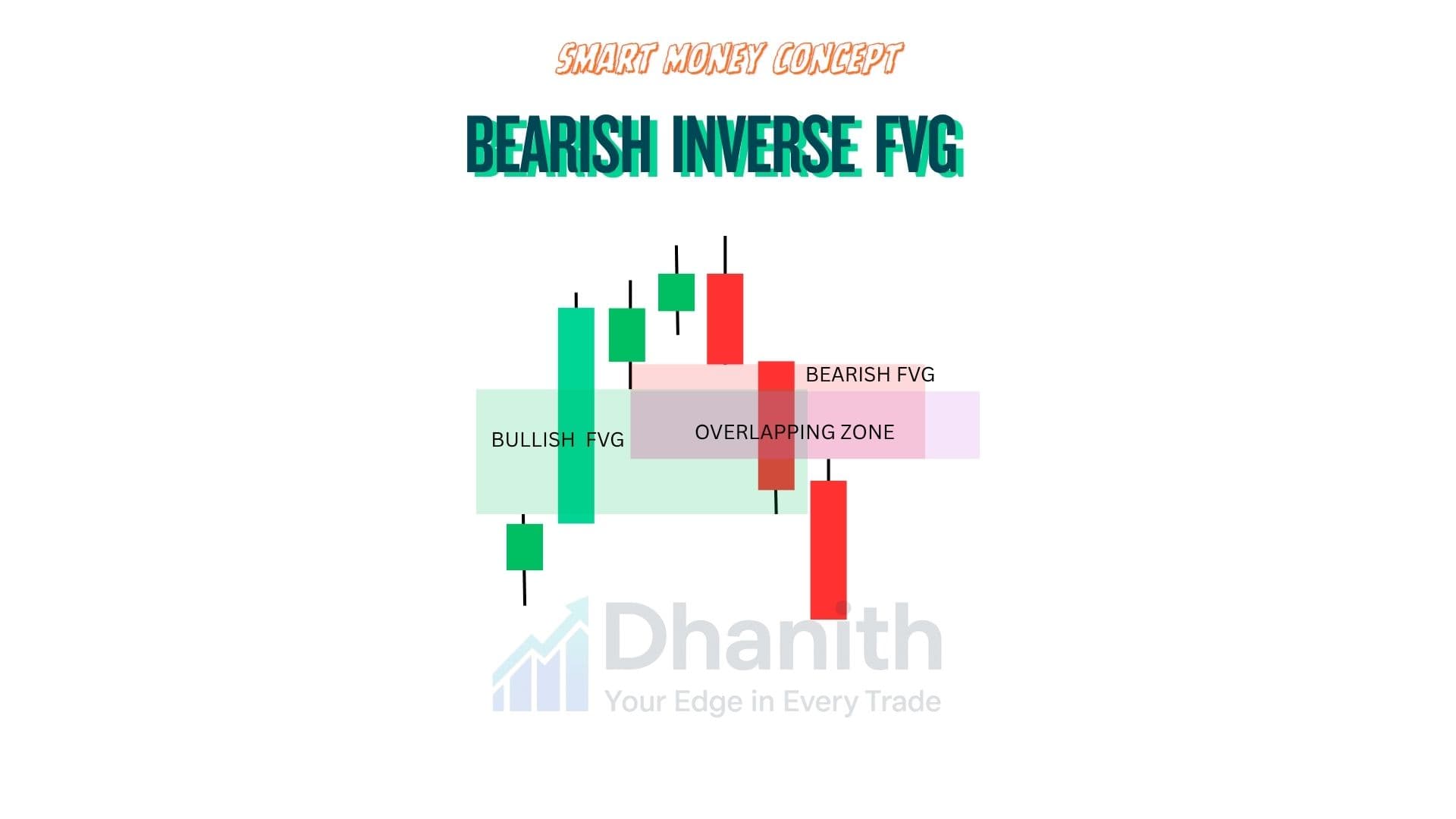
An Inverse Fair Value Gap (IFVG) — also called an Inversion FVG — forms when price violates a standard FVG entirely, causing the zone to flip polarity.
Formation sequence:
- A standard bullish FVG forms (candle 1 high below candle 3 low)
- Price returns to the bullish FVG zone and initially holds (normal reaction)
- Price then closes below the bullish FVG — violating the entire zone
- The former bullish FVG is now invalidated as support
- It becomes a bearish IFVG — acting as resistance when price revisits from below
The reverse applies for bearish FVGs that become bullish IFVGs.
Why IFVGs work: When a bullish FVG fails to hold and price closes through it, the institutional orders that were defending that zone have been overwhelmed. The institutions that were buying at the FVG are now trapped in losing positions. When price rallies back to the zone, those trapped longs exit (selling their positions), creating the resistance that makes the IFVG zone react as resistance.
Three conditions for a valid IFVG:
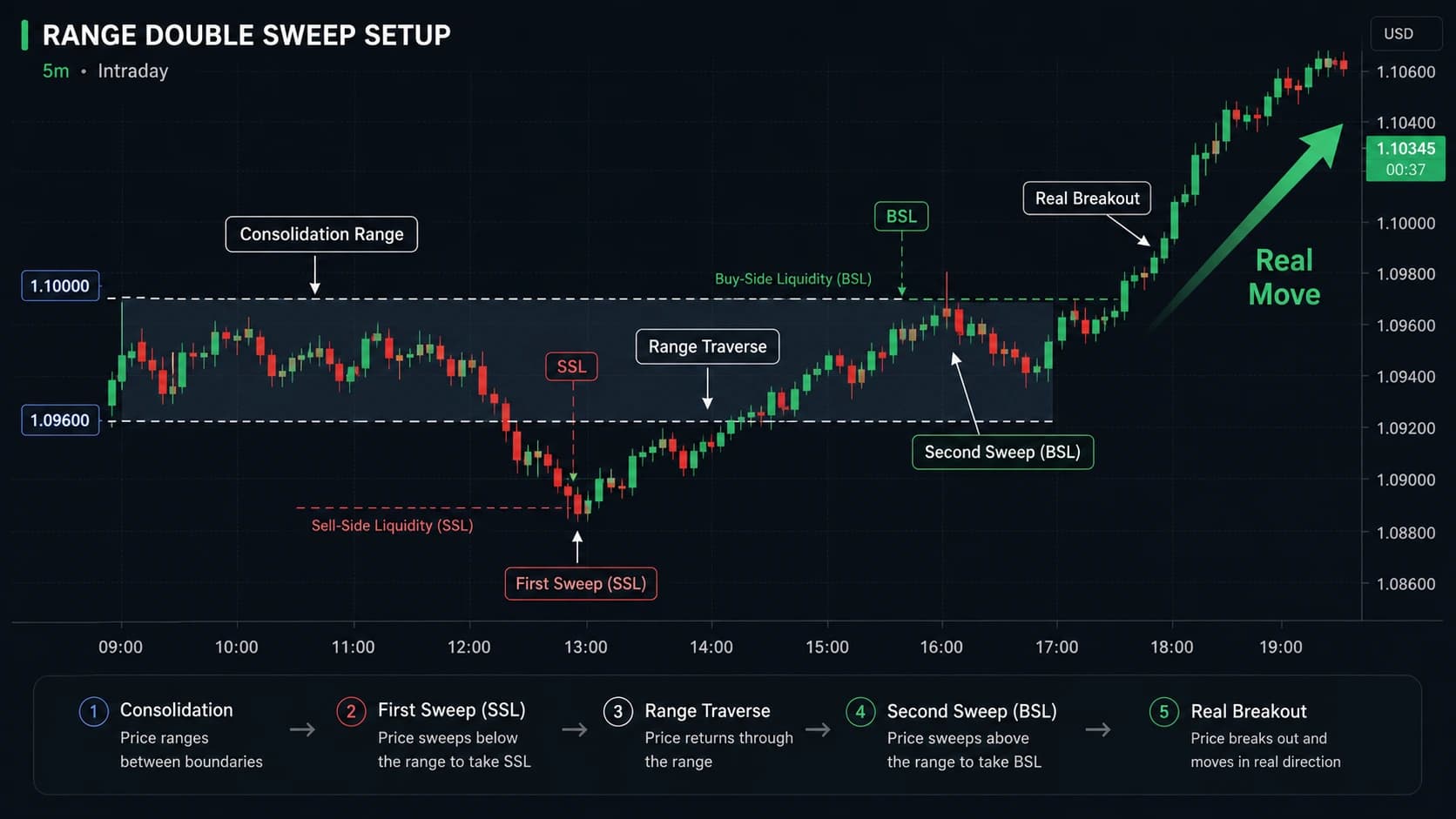
- Liquidity sweep first — before price violates the FVG, a liquidity sweep of nearby stops should occur
- Clean close through the FVG — a full candle body close beyond the FVG edge, not just a wick
- Structure shift context — the FVG violation should align with a CHoCH or MSS on the same timeframe
Type 5: Implied Fair Value Gap
An Implied Fair Value Gap is a gap where candle bodies appear to overlap, suggesting no FVG exists — but the candle wicks reveal a non-overlapping space that algorithms recognize as an imbalance.
In other words: the visible candle bodies may appear to trade through a price area, but the wicks show that price never actually transacted at those levels. The "gap" is implied by the wick structure rather than immediately obvious on the chart.
How to identify implied FVGs: Using a Fibonacci retracement tool, measure from candle 1's wick extreme to candle 3's wick extreme. If the 50% level (CE) of this measurement creates a zone where no actual closing price occurred, an implied FVG exists — even if the chart does not show a visible gap.
Trading implied FVGs: Because they are harder to see visually, implied FVGs are less crowded with retail traders. Reactions at implied FVG levels can be sharp and decisive, precisely because fewer traders have the zone marked. The entry logic is identical to standard FVGs — CE entry, stop beyond the zone edge, target next liquidity pool.
Type 6: Institutional Fair Value Gap (High-Volume FVG)
An Institutional FVG is a standard FVG confirmed by significantly above-average volume on the displacement candle. For US stocks, this means the volume on the displacement candle is 2x–3x the 20-period average volume.
The distinction matters because:
- High-volume displacement = large institutional participation confirmed
- Low-volume displacement = potentially retail-driven, less reliable
- Reactions at institutional FVGs tend to be sharper and more sustained
When screening FVGs on stocks, always check the volume of the displacement candle. An FVG formed on thin volume is a lower-confidence setup regardless of how clean the three-candle structure appears.
Comparison Table: FVG Types at a Glance
| FVG Type | Direction | Formation | Behavior | Probability |
|---|---|---|---|---|
| Bullish FVG | Upward | C1 high below C3 low | Support on retracement | High (with trend + OB) |
| Bearish FVG | Downward | C1 low above C3 high | Resistance on rally | High (with trend + OB) |
| Consequent Encroachment | N/A | 50% midpoint of any FVG | Highest reaction level within FVG | Highest within gap |
| Inverse FVG (IFVG) | Flipped | Violated FVG that flips polarity | Acts opposite direction | High (after liquidity sweep) |
| Implied FVG | Either | Wick-implied gap, no body overlap needed | Same as standard FVG | Medium-High |
| Institutional FVG | Either | Standard FVG on 2x+ volume | Sharper, more reliable reaction | High |
Part 3: The Data — FVG Fill Rates and Real Statistics
Before committing capital to any methodology, the data must be examined honestly.
The headline statistic: FVGs fill approximately 70–75% of the time. This is the commonly cited figure across the SMC trading community, consistent with what professional traders observe in practice.
What the research actually says:
A 2026 academic analysis of 32,202 FVG events across four asset classes found that 30–45% of detected FVGs fail to produce predictable reactions when identified by mechanical detection alone (no quality filters applied). This seems contradictory — but it isn't. The key finding from the same research was that FVGs with slow formation speed (gradual, deliberate displacement rather than explosive gap candles) generated 3.2x stronger reactions and achieved over 75% win rate in backtests.
What this tells us: FVG quality varies enormously. Raw detection of every three-candle imbalance produces mediocre results. Filtered, high-quality FVGs — identified by displacement speed, volume, structural context, and premium/discount positioning — produce win rates approaching 75%+.
Edgeful's live market data (YM Futures, 30-minute charts, thousands of setups) showed a 63% hold rate for FVGs used as support/resistance — not as fill targets. This is a critical statistical insight: you are not trying to predict that a gap will fill. You are entering with the expectation that the zone will hold and reverse price. That framing — FVG as support/resistance, not as fill magnet — is what produces 63%+ win rates in live conditions.
The confluence multiplier: When FVGs are combined with order blocks at the same zone, the win rate increases substantially. Research and practitioner data consistently show that OB + FVG setups outperform standalone FVGs by 8–15 percentage points.
The timeframe effect: FVGs on lower timeframes (1-minute, 3-minute) are essentially noise. FVGs on the 15-minute and 30-minute timeframes produce the best balance of opportunity frequency and reliability for stock day traders. Daily FVGs carry the most institutional significance but are too slow for intraday execution.
The summary: Trade FVGs as high-probability zones for continuation entries — not as guaranteed fill targets. Apply quality filters. Use the correct timeframe. Combine with order blocks. Manage risk at 2:1 minimum.
Part 4: The FVG Quality Grading System — 6 Criteria
Not all FVGs deserve the same trade allocation. Before entering any FVG trade, score the setup across these six criteria.
Criterion 1 — Higher Timeframe Trend Alignment (0–3 points)
| Alignment | Score |
|---|---|
| FVG direction matches weekly AND daily AND 4H trend | 3 points |
| FVG direction matches daily AND 4H trend | 2 points |
| FVG direction matches daily trend only | 1 point |
| FVG is counter-trend at the daily level | 0 points |
Criterion 2 — Displacement Quality (0–2 points)
| Displacement | Score |
|---|---|
| Large, aggressive displacement candle with volume 2x+ average | 2 points |
| Standard displacement candle with above-average volume | 1 point |
| Weak, grinding move or below-average volume | 0 points |
Criterion 3 — Mitigation Status (0–2 points)
| Mitigation Status | Score |
|---|---|
| Completely fresh — price has never entered the FVG | 2 points |
| Partially filled — price entered but did not close through | 1 point |
| Fully mitigated — price has traded through the entire FVG | 0 points |
Criterion 4 — Premium/Discount Zone (0–2 points)
| Zone Position | Score |
|---|---|
| Bullish FVG in discount zone (below 50% Fibonacci of current swing) | 2 points |
| Bearish FVG in premium zone (above 50% Fibonacci of current swing) | 2 points |
| FVG in equilibrium zone (near 50%) | 1 point |
| FVG in the wrong zone (bullish in premium, bearish in discount) | 0 points |
Criterion 5 — Order Block Confluence (0–2 points)
| OB Overlap | Score |
|---|---|
| FVG completely overlaps with a valid, unmitigated order block | 2 points |
| FVG partially overlaps with a valid order block | 1 point |
| No order block at the FVG zone | 0 points |
Criterion 6 — Structural Context (0–1 point)
| Structural Context | Score |
|---|---|
| FVG was created by a displacement that caused a BOS or CHoCH | 1 point |
| FVG was created by a displacement that did not break structure | 0 points |
The FVG Grading Scale
| Total Score | Grade | Trading Action |
|---|---|---|
| 11–12 points | Grade A+ | Maximum position size — highest conviction entry |
| 8–10 points | Grade A | Full standard position size |
| 5–7 points | Grade B | Half position size — take only in strong trending conditions |
| 2–4 points | Grade C | Skip — too many quality flags |
| 0–1 points | Invalid | Do not trade |
Warning: Most FVGs you identify in a typical trading session will grade B or lower. That is correct and expected. The purpose of the grading system is to force you to trade only the minority of setups that have true institutional backing. A discipline of "Grade A and above only" will dramatically improve average trade quality within weeks of implementation.
Part 5: Five Proven FVG Trading Strategies
Strategy 1 — The Basic FVG Retracement Entry
The foundational FVG strategy. Simple, clean, and effective when the quality filters are applied.
Setup conditions:
- Identify a valid FVG (bullish or bearish) that scores Grade B or higher
- Confirm the FVG is in the correct premium/discount zone
- Confirm higher timeframe trend alignment
- The FVG must be fresh (unmitigated)
Entry execution: Wait for price to retrace into the FVG zone. Do not enter the moment price touches the edge — wait for price to reach the Consequent Encroachment (CE, the 50% midpoint). Set a limit order at the CE level.
Stop loss: Just beyond the far edge of the FVG. Add a small buffer of 0.1–0.2% to account for stop hunts that briefly exceed the FVG edge.
Target: The next significant liquidity pool in the direction of the trade. Minimum 2:1 risk-reward.
Best timeframe for stocks: 15-minute and 30-minute FVGs during the New York AM session (9:30–11:00 AM ET). Daily FVGs for swing trades, with 4-hour or 1-hour entry timing.
Strategy 2 — The OB + FVG Confluence Entry (Highest Probability)
This is the highest-probability setup in all of SMC trading. When a valid order block and a fair value gap occupy the same price area, you have two independent institutional signals confirming the same zone.
Setup identification:
- Identify a valid order block (last opposing candle before displacement + BOS)
- Check whether an FVG formed within the displacement impulse that originated from the OB
- If the OB zone and the FVG zone overlap — even partially — you have the confluence zone
The overlap zone: When the OB and FVG share price levels, the overlapping area is the "golden zone" — the highest-probability entry range on the chart. Mark this overlap area separately from the individual OB and FVG zones.
Entry execution: Place a limit order at the 50% level of the overlapping zone. Stop below the OB's lowest wick (for bullish setups). Target: the next major liquidity pool on the higher timeframe. For Grade A+ OB + FVG setups during clear trends, targets of 3:1 to 5:1+ are achievable and expected.
Practical example (stock day trade):
- SPY daily trend: bullish (HH/HL sequence intact)
- 4-hour chart: Price makes a bullish BOS, creating a valid bullish OB. The BOS displacement also creates a bullish FVG that overlaps with the upper half of the OB zone.
- Price retraces to the OB/FVG confluence zone during the morning session
- Limit buy placed at the CE of the overlapping zone
- Stop below the OB wick low
- Target: the next swing high on the 4-hour chart
- Risk-reward: 3.2:1
Strategy 3 — The Liquidity Sweep + FVG Entry (The Trifecta)
This strategy adds the liquidity sweep component to the OB + FVG foundation — creating the highest-confidence three-element setup in SMC trading.
The trifecta sequence:
- Liquidity sweep: Price briefly moves below a key swing low (for bullish setups) — triggering the stop losses of long traders and the sell stops of breakout sellers
- FVG retest: After the sweep, price reverses sharply back upward and enters a bullish FVG zone (ideally with an overlapping OB)
- Lower timeframe confirmation: On the 5-minute or 15-minute chart, a bullish CHoCH or MSS forms within the FVG zone, confirming the reversal
Entry execution: After the lower timeframe MSS confirms, enter at market or limit at the 15-minute MSS's structural level. Stop below the sweep low (the lowest wick of the liquidity sweep candle). Target: the next buy-side liquidity pool on the 4-hour chart.
Why this is the cleanest setup:
- The liquidity sweep confirms institutional involvement — they engineered the sweep to collect orders
- The FVG provides the magnetic zone for price to return to and react
- The LTF MSS provides entry confirmation — you're not guessing; you have three layers of evidence
When all three elements align — sweep, FVG (ideally with OB), and LTF MSS — size up to maximum position.
Strategy 4 — The Inverse FVG Reversal (IFVG Trade)
An advanced strategy for traders who can read structural shifts. This setup enters on the retest of a broken FVG — trading in the opposite direction of the original FVG's intention.
Setup sequence:
- A standard bullish FVG forms and price initially holds at the zone (normal behavior)
- A liquidity sweep occurs at or below the FVG zone
- Price then closes below the bullish FVG with a strong displacement candle — invalidating the original FVG
- The zone is now a bearish IFVG
- Price rallies back up to retest the former bullish FVG zone from below
- Enter short at the CE level of the IFVG
- Stop above the IFVG's highest wick
- Target: the next sell-side liquidity pool below
Why IFVGs work at this specific moment: The traders who were long at the bullish FVG are now trapped — price traded through their zone and they're in losing positions. When price rallies back to the IFVG zone, many of those trapped longs exit, adding selling pressure that reinforces the IFVG as resistance.
Grade A IFVG requirements:
- Preceded by a liquidity sweep (not just a random violation)
- Violation candle closes cleanly through the entire FVG zone — not just a wick
- Alignment with the higher timeframe structure
- The IFVG zone sits in premium (for bearish IFVG) or discount (for bullish IFVG)
Strategy 5 — The Multi-Timeframe FVG Cascade (Advanced)
The most advanced FVG strategy — and the most complete. It uses FVGs across multiple timeframes simultaneously, creating a cascading confirmation system.
The cascade structure:
- Weekly FVG establishes the macro direction
- Daily FVG establishes the weekly sub-target and the daily trade direction
- 4-Hour FVG provides the specific setup and entry zone
- 15-Minute FVG provides the precise entry trigger and tight stop placement
How to execute the cascade:
- Identify a weekly FVG that price has not yet filled — your macro target
- On the daily chart, identify a daily FVG aligned with the direction toward the weekly FVG
- Drop to the 4-hour chart — find an OB + FVG confluence zone aligned with the daily direction
- Drop to the 15-minute chart — wait for a fresh 15-minute FVG to form within the 4-hour zone as price retraces
- Enter at the 15-minute FVG's CE, stop below the 15-minute FVG's lower wick, target the daily FVG level (first target) then the weekly FVG (ultimate target)
Why the cascade works: Each timeframe's FVG is an independent institutional footprint pointing in the same direction. When all four timeframes align, you have an extraordinarily high-confidence trade with a tight initial stop and massive potential reward.
Part 6: FVG Entry, Stop Loss, and Target — The Complete Rules
Entry Precision — Where Exactly to Enter
For Grade A and A+ setups: Limit order at the CE (50% midpoint) of the FVG. This is the optimal entry level — it maximizes risk-reward by placing the entry at the most institutionally relevant level within the zone while keeping the stop as tight as possible.
For Grade B setups (lower conviction): Wait for a rejection candle at the CE level before entering. For longs: wait for a bullish engulfing, hammer, or pin bar at the CE. For shorts: wait for a bearish engulfing, shooting star, or pin bar.
Never enter FVGs with market orders at the top edge: Entering the moment price touches the FVG's near edge places your entry at the worst possible level within the zone — before the institutional reaction has even begun. This produces wide stops, poor risk-reward, and frequent false entries.
Stop Loss — The Definitive Rules
The universal FVG stop loss rule: Stop goes just beyond the far edge of the FVG — not inside the gap, not at the CE.
For bullish FVG long trades: Stop below the lower wick extreme of the FVG (candle 1's high, which forms the FVG's bottom boundary) plus a 0.1–0.2% buffer.
For bearish FVG short trades: Stop above the upper wick extreme of the FVG (candle 1's low, which forms the FVG's top boundary) plus a 0.1–0.2% buffer.
Why not inside the FVG? Institutional order placement often causes price to extend slightly beyond the CE before reacting. If your stop is at the CE, a brief dip below the entry level — which is normal institutional behavior within the FVG zone — will stop you out before the expected reaction occurs.
Warning: Do not widen your stop because the trade "feels" like it should work. If you need to widen the stop beyond the FVG's far edge to make the trade viable, that's a signal the setup is low quality — not that your stop is too tight. Accept the defined risk or skip the trade.
Target Setting — Reaching the Next Liquidity Pool
Primary target: The nearest opposing liquidity pool in the direction of the trade.
- Long trade: the nearest swing high (buy-side liquidity), equal highs, or prior all-time high
- Short trade: the nearest swing low (sell-side liquidity), equal lows, or prior all-time low
Minimum risk-reward: 2:1. If the setup cannot achieve 2:1, it fails the quality threshold regardless of how high it scores on other criteria.
Scaling out approach for Grade A+ setups:
- At 1:1 (risk covered): Take 25% of the position off, move stop to breakeven
- At 2:1: Take another 25% off
- Let the remaining 50% run to the full liquidity target
Part 7: FVGs Across Timeframes — The Complete Stock Trader Framework
Timeframe Roles for Stock FVG Traders
| Timeframe | FVG Role | Significance |
|---|---|---|
| Weekly | Macro directional FVG | Highest significance — major institutional imbalances, weeks/months to fill |
| Daily | Trade direction FVG | High significance — establishes daily bias and multi-day swing targets |
| 4-Hour | Setup FVG | Medium-high — primary entry zone identification for swing and day trades |
| 1-Hour | Context FVG | Medium — confirms 4H setup and provides intraday context |
| 15-Minute | Entry trigger FVG | Lower-medium — used for precise entry timing within 4H zones |
| 5-Minute | Execution FVG | Low individual significance — used for tight stop placement only |
The Top-Down FVG Analysis Process
Step 1 — Weekly chart: Are there any significant unmitigated weekly FVGs within 5–10% of the current price? Mark them. These are the most powerful magnetic zones on the chart.
Step 2 — Daily chart: Identify unmitigated daily FVGs aligned with the weekly direction. Grade each on the 6-criteria system. Only Grade A or higher daily FVGs become active trade setups.
Step 3 — 4-Hour chart: Within the daily FVGs identified, find 4-hour FVGs that overlap with valid order blocks. These confluence zones are the highest-probability entry areas.
Step 4 — 15-Minute chart: On the day of execution, watch the 15-minute chart as price approaches your pre-marked 4H zone. Wait for a fresh 15-minute FVG to form within the 4H zone — this is the entry trigger.
Step 5 — Monitor, not manage: Once in the trade, do not watch the 1-minute or 3-minute chart. Return to the 15-minute or 4-hour chart for trade management decisions. Lower timeframe noise will create false impulses to exit prematurely.
Stock-Specific FVG Considerations
Session timing: For US stocks, the highest-probability FVG setups occur during the New York AM session (9:30–11:00 AM ET). FVGs that form during the lunch lull (11:30 AM–1:00 PM ET) have significantly lower reliability.
Pre-market FVGs: Be cautious with FVGs that form in pre-market or after-hours trading. Volume is thin and institutional participation is minimal.
Earnings and news events: Do not trade FVGs around earnings announcements or major macro events. The price gaps created by these events are news-driven, not institutional-strategy-driven.
Volume confirmation on stocks: Always check the displacement candle's volume against the 20-period average. An FVG formed on 2x+ average volume is institutionally confirmed. An FVG formed on below-average volume is suspect regardless of the three-candle structure.
Part 8: FVG in the Broader SMC Framework
How FVGs Relate to Order Blocks
An order block is where institutions placed orders before a displacement move. A fair value gap is what that displacement created — the imbalance left behind.
These two concepts are complementary institutional footprints of the same event:
- The OB tells you where the institution entered
- The FVG tells you how aggressively they entered
When both occupy the same zone, you have complete institutional intelligence: the specific level (OB) and the urgency confirmation (FVG). This is why OB + FVG confluence is the highest-probability configuration in SMC.
The practical relationship: OBs without FVGs are valid but less confirmed. FVGs without OBs are valid but lack the specific institutional entry level. OBs WITH FVGs provide both the entry zone and the imbalance confirmation. Always look for both.
How FVGs Relate to Market Structure
FVGs created by BOS moves are the most significant. Understanding market structure is essential because the structural FVG is the first place to look for re-entries after a BOS:
- Price makes a bullish BOS with a strong displacement candle
- The displacement leaves a bullish FVG
- Price retraces toward the FVG on the next pullback
- Entry at the FVG's CE continues the trade in the direction of the BOS
This is the "BOS reentry via FVG" setup — one of the most consistently profitable sequences in structural price action trading.
How FVGs Relate to Liquidity
FVGs and liquidity are interconnected. The liquidity sweep that precedes a displacement move creates the directional fuel. The displacement then creates the FVG.
The ideal sequence:
- Liquidity sweep (stop hunt) below a swing low
- Sharp reversal upward (displacement) — the FVG forms here
- Price retraces into the FVG
- You enter long with the institutional order flow
Without the prior liquidity sweep, the FVG may simply be a temporary pause before price continues in the pre-existing direction.
How FVGs Relate to the AMD Cycle (Power of 3)
In the daily Power of 3 (AMD) cycle:
- Accumulation phase (Asia session): Range-bound, low volume — no meaningful FVGs typically form here
- Manipulation phase (London open): The fake move in one direction sweeps liquidity — may create small FVGs in the manipulation direction (these are IFVG setups)
- Distribution phase (New York session): The real institutional move — this is where the most reliable FVGs form
For US stock traders, FVGs that form during the New York AM session (9:30–11:00 AM ET) are the most reliable. These are distribution-phase FVGs — driven by genuine institutional directional moves, not manipulation.
Part 9: Building a Complete FVG Trading Routine
Pre-Market Preparation (7:00–9:15 AM ET)
Weekly and Daily FVG scan (15 minutes): Open each stock on your 5–10 stock watchlist. On the daily chart, scan for unmitigated FVGs within 3–5% of current price. Mark each one. Grade each on the 6-point system. Only Grade A and A+ FVGs make the active watchlist.
Contextual alignment check (10 minutes): For each Grade A daily FVG, check:
- Is the daily trend aligned with the FVG direction?
- Does the FVG overlap with an unmitigated order block?
- Is the FVG in the correct premium/discount zone?
- Are there any earnings or major news events today that could override the setup?
Pre-mark the entry levels: For each priority setup, identify the FVG zone, the CE level (50% midpoint), the stop loss level (beyond the far FVG edge), the target level, and the risk-reward ratio (must be 2:1 minimum).
Set a price alert at the FVG's near edge so you're notified when price approaches the zone.
Session Execution (9:30–11:30 AM ET)
9:30–10:00 AM — Observation only: Watch the open. Note which direction price moves first — this often reveals the manipulation phase direction. Do not enter in the first 15 minutes. Let the AMD cycle establish itself.
10:00–11:00 AM — Primary entry window: As price approaches your pre-marked FVG zones, switch to the 15-minute chart. Watch for price entering the FVG zone, a reaction at the CE level, volume confirmation on the reaction candle, and lower timeframe MSS if using Strategy 3.
Entry discipline: Only enter if the setup is on your pre-market watchlist and the price alert has triggered appropriately. Do not identify new FVGs and enter them during the session.
Post-Session Review (4:30–5:30 PM ET)
Journal every setup (30 minutes): Record every setup that triggered today — whether you entered or not. For each: FVG grade, whether you entered and why, entry/stop/target prices, outcome, and what you would do differently.
Update your charts: Mark mitigated FVGs as such. Remove fully mitigated FVGs. Note any new Grade A FVGs that formed during the session for potential future setups.
Dhanith Trading Journal
Track every trade. Find your real edge.
Log your setups, grade your entries, and review your trading patterns — all in one place. The journal built for serious SMC traders.
Part 10: The Most Common FVG Mistakes — And Exact Fixes
Mistake 1 — Entering the Moment Price Touches the FVG Edge
The fix: Enter at the CE (50% midpoint) of the FVG with a limit order. Let price come to your level. If it doesn't — if it bounces immediately off the near edge — that's a missed trade, not a bad trade.
Mistake 2 — Trading FVGs in Ranging/Choppy Markets
The fix: Before trading any FVG, identify the market state on the daily chart. FVG strategies produce their best results in trending markets. In ranging markets, dramatically reduce FVG trade frequency or stop entirely and wait for a clean BOS out of the range.
Mistake 3 — Ignoring Premium/Discount Zone
The fix: Before every FVG trade, draw a Fibonacci tool over the current swing range. Verify the bullish FVG sits below the 50% level (discount). If not — wait for price to reach the discount zone or skip the setup.
Mistake 4 — Treating Every Three-Candle Structure as a Valid FVG
The fix: Apply the displacement requirement. A valid FVG requires a displacement candle — a notably large, aggressive middle candle significantly larger than the surrounding candles. If the "FVG" was created by a small, ordinary candle, it is routine price movement — not institutional order flow. Delete it.
Mistake 5 — Not Checking Volume on Stock FVGs
The fix: On every stock FVG, check the displacement candle's volume against the 20-period average. For a Grade A FVG, the displacement candle should have volume at or above 1.5x the 20-period average. Below-average volume on the displacement candle drops the setup to Grade B at best.
Mistake 6 — Expecting Every FVG to Fill Completely
The fix: The CE is the highest-probability reaction level — not the full FVG fill. Use the CE as your primary entry level. Do not wait for the full fill before entering — you'll miss the best entries and accumulate the worst ones.
Mistake 7 — Trading FVGs Around Earnings and News Events
The fix: Check the earnings calendar before marking any stock FVG for the next trading session. If the stock has earnings within the next 48 hours, remove it from your FVG watchlist. Earnings-driven price gaps behave differently — they can fill, continue, or reverse with no predictable institutional pattern.
Mistake 8 — Placing Stop Inside the FVG Body
The fix: Stop must be beyond the far edge of the FVG with a buffer. The far edge is the invalidation level — not the CE, not the midpoint, not "somewhere in the gap." If price closes beyond the far edge, the FVG is fully mitigated. Until that happens, the setup remains valid.
FAQ
Q: What is a fair value gap in stock trading? A fair value gap (FVG) is a three-candle price pattern where aggressive institutional buying or selling moves price so quickly that it skips certain price levels, leaving an imbalance between the outer wicks of candles 1 and 3. In stock trading, FVGs most reliably form during the New York AM session on the 15-minute through daily timeframes.
Q: How often do fair value gaps fill? Research and practitioner data shows that FVGs fill approximately 70–75% of the time overall. When quality filters are applied — trend alignment, displacement confirmation, premium/discount positioning, and order block confluence — high-grade FVG setups achieve fill or reaction rates of 60–75% on live market data.
Q: What is the difference between a fair value gap and an order block? An order block is the specific candle where institutional orders were placed before a displacement move — the entry point of the institution. A fair value gap is the price imbalance created by that displacement — the zone skipped over by the move. Both are institutional footprints of the same event: the OB shows where, the FVG shows how aggressively. When both occupy the same price zone (OB + FVG confluence), the setup carries the highest probability in SMC trading.
Q: What is Consequent Encroachment (CE) in FVG trading? Consequent Encroachment (CE) is the 50% midpoint of any fair value gap. It is the highest-probability entry level within the FVG zone — price frequently reacts at the CE rather than requiring a complete fill of the entire gap. Entering at the CE provides a tighter stop and better risk-reward than waiting for full gap fill.
Q: What is an Inverse Fair Value Gap (IFVG)? An IFVG forms when price violates a standard FVG — closes through the entire gap zone — causing the zone to flip polarity. A bullish FVG that gets broken becomes a bearish IFVG, acting as resistance when price returns to that zone. IFVGs require a liquidity sweep before the violation and a clean candle close through the gap to be valid.
Q: What timeframe is best for FVG trading in stocks? For day trading US stocks, the 15-minute and 30-minute timeframes provide the best balance of signal quality and opportunity frequency. For swing trading, the daily and 4-hour charts identify the primary setups, with 1-hour or 15-minute entries. Daily FVGs carry the most institutional significance for medium-term analysis.
Q: How do I know if a fair value gap is still valid? A bullish FVG is valid until price closes below the FVG's lower boundary (candle 1's high). A bearish FVG is valid until price closes above the FVG's upper boundary (candle 1's low). Wicks that extend through the FVG but candles that close back inside the zone do not invalidate the FVG — they are often liquidity sweeps at the zone boundary before the genuine reaction. Only a full candle body close through the far edge constitutes invalidation.
Conclusion
Fair value gaps are not a trend. They are not a trading fad that will stop working when enough people learn about them.
They are a structural feature of how institutional order flow operates in any liquid market. The mechanics that create them — large orders that move price too quickly for normal two-sided trading to occur — are inherent to how institutions must operate. As long as banks, funds, and institutional players dominate volume in equity markets, fair value gaps will continue to form and react predictably.
What changes is not the pattern — it is the quality of the analysis applied to it.
The three most important principles from this guide:
1. Quality over quantity. Most FVGs you see on a chart are Grade B or lower. Trade only Grade A and above — fewer entries, better outcomes.
2. The CE is the entry, not the full fill. Waiting for a complete FVG fill produces late entries and poor risk-reward. The CE (50% midpoint) is where institutional defense is strongest and where your entry belongs.
3. Context determines everything. An FVG in the wrong trend, in the wrong premium/discount zone, without structural confirmation, is not a setup — it's a random zone. Context — HTF trend, structural BOS, premium/discount, OB confluence — is what converts a mechanical pattern into an institutional edge.
Master those three principles and the five strategies in this guide, and fair value gap trading becomes one of the clearest, most mechanically sound approaches to institutional price action available to retail stock traders in 2026.
The gaps are there on every chart. Now you know exactly what they mean, why they form, and how to trade them with precision.
Related Articles
- Smart Money Concepts: The Complete Mastery Guide — The full SMC framework that places fair value gaps in context alongside order blocks, liquidity sweeps, and market structure
- SMC Market Structure: BOS, CHoCH and Strong vs Weak Levels — FVGs created by BOS displacement moves are the most significant — learn to read the structural context behind every gap
- Order Blocks: The Complete Mastery Guide — When an FVG overlaps with an order block at the same zone, you have the highest-probability setup in SMC
- Liquidity Sweeps: The Complete Mastery Guide — The sweep-then-FVG sequence is one of the cleanest institutional entry patterns available
- Premium and Discount Zones: Complete SMC Guide — A bullish FVG in the premium zone has low probability — learn how to position FVG entries correctly
- Accumulation, Manipulation, Distribution (AMD Cycle) — FVGs that form during the distribution phase carry maximum reliability; gaps from the manipulation phase are traps
Disclaimer: This article is for educational purposes only and does not constitute financial or investment advice. Stock trading involves significant risk of loss. Past performance of any trading pattern or strategy does not guarantee future results. Always use proper risk management and only trade with capital you can afford to lose.
Continue Reading