Liquidity Sweeps: The Complete Mastery Guide for Stock Traders (2026)
Master liquidity sweeps in 2026. Learn buy-side vs sell-side liquidity, how to identify stop hunts, liquidity sweep vs breakout, 4 proven strategies, entry models, and the 8 most common mistakes — with stock trading examples.
Introduction
You've placed a stop loss below support a hundred times. You know the level. You marked it carefully. You're confident.
Then it happens — again. Price dips just below your stop, fills it, and within minutes reverses sharply upward, proceeding exactly where you originally expected. Your analysis was right. Your stop was right. And yet you're out, watching the move happen without you.
That was not bad luck. That was a liquidity sweep.
And once you understand what happened — truly understand the institutional mechanics behind it — you will never again feel like the market is out to get you personally. Because it isn't targeting you. It is targeting the cluster of orders sitting at the most obvious level on the chart. The one every retail trader marked.
Liquidity sweeps are the single most important concept in understanding how institutional order flow actually operates. Every other SMC concept — order blocks, fair value gaps, market structure, the AMD cycle — connects back to one foundational reality: institutions need your stop losses to fill their orders. The sweep is how they collect that liquidity. The reversal that follows is the real move.
TL;DR — Key Takeaways
- A liquidity sweep is a deliberate price move beyond a key level to collect resting stop orders before reversing in the opposite direction
- Buy-side liquidity (BSL) sits above swing highs — swept to create sell-side institutional positioning
- Sell-side liquidity (SSL) sits below swing lows — swept to create buy-side institutional positioning
- The sweep itself is not the entry — the reversal after the sweep, confirmed by a lower timeframe CHoCH or MSS, is the entry
- Equal highs and equal lows are the most predictable sweep targets — they attract the largest stop clusters
- A genuine breakout holds beyond the level with structure; a sweep returns inside the range immediately
- Stop loss goes below the swept low (for longs) or above the swept high (for shorts) — beyond the wick extreme
- Liquidity sweeps work across all timeframes but are most reliable during high-volume session opens (NY AM for stocks)
Part 1: What Is a Liquidity Sweep? The Complete Institutional Explanation
The Market Needs Your Orders
Every trade you execute requires a counterparty. For institutions, the problem is enormous: when a hedge fund wants to buy 5 million shares of a stock, it cannot simply click buy. That order, executed directly at market, would push the price dramatically upward against itself — creating enormous slippage before the position is even half-filled.
Institutions solve this problem by accessing liquidity pools — clusters of resting orders that provide the counterparty volume they need to fill large positions without excessive slippage. And the largest, most predictable clusters of orders sit exactly where retail traders place their stop losses: just beyond the most obvious swing highs and swing lows.
The Mechanics of a Liquidity Sweep
A liquidity sweep unfolds in a specific, repeatable sequence:
Step 1 — Liquidity builds: Retail traders identify a swing high or low as a key level. Those who are long place stop losses below the swing low. Those who are short place stops above the swing high. Over time, a large cluster of orders accumulates just beyond the level.
Step 2 — Institutional detection: Institutional algorithms identify the order cluster as a pool of liquidity they can use to fill large opposing positions.
Step 3 — The sweep: Institutions push price through the level — briefly spiking above the swing high or below the swing low. This triggers every stop loss and pending order in the cluster.
Step 4 — Institutional positioning: The institution fills its large position at favorable prices, using the triggered retail orders as counterparty volume.
Step 5 — The reversal: With its position filled, the institution no longer supports the price beyond the swept level. Price falls back below the swept level and continues in the institutional direction.
Step 6 — The real move: Price moves in the true institutional direction. Every retail trader who was stopped out or caught in the false breakout funded the institutional entry.
Pro Tip: The next time you see price spike just above a swing high and immediately reverse, do not feel frustrated. That was an institution filling a large sell order using your buy stops as liquidity. Next time, instead of getting stopped out at the obvious level, you want to be positioned short after the sweep completes — aligned with the institution that just filled.
Liquidity Sweeps vs. Wyckoff — The Historical Context
The concept of liquidity sweeps is not new. Richard Wyckoff described the same behavior nearly a century ago:
- Wyckoff's Spring = SMC sell-side liquidity sweep
- Wyckoff's Upthrust = SMC buy-side liquidity sweep
- Wyckoff's Test = the retest of the swept level from the new direction
Part 2: Where Liquidity Pools Form — Mapping the Market
Buy-Side Liquidity (BSL)
Buy-side liquidity sits above the market. The most significant BSL pools form at:
1. Swing Highs: Every clearly visible peak on a chart attracts stop orders above it. The more prominent the swing high, the more stops are clustered above it.
2. Equal Highs (Relative Equal Highs / REH): When price creates two or more peaks at nearly the same level, every retail trader recognizes it as "double top resistance" and places stops just above it. This is the most predictable liquidity pool in all of SMC.
3. Prior Day/Week Highs: Algorithmic systems track these levels and retail traders reference them constantly.
4. Round Numbers: $100, $150, $200. Psychological price levels attract disproportionate order concentration.
5. Prior All-Time Highs: The most significant BSL level on any long-term chart.
Sell-Side Liquidity (SSL)
Sell-side liquidity sits below the market. The most significant SSL pools form at:
1. Swing Lows: Every clearly visible trough attracts sell stops below it.
2. Equal Lows (Relative Equal Lows / REL): Two or more lows at the same level form the most predictable SSL pool. Every trader sees "double bottom support" and places stops just below.
3. Prior Day/Week Lows: Systematically tracked by algorithmic and institutional systems.
4. Round Numbers Below Current Price.
5. Prior All-Time Lows.
Internal vs. External Liquidity
External liquidity sits at the obvious swing highs and lows that define the trend — primary targets for sweeps before major directional moves.
Internal liquidity sits within the price range between major swings — targeted before intermediate-term moves and during intraday AMD cycles.

Part 3: Types of Liquidity Sweeps — Every Variation
The Sell-Side Liquidity Sweep (Bullish Setup)
What happens: Price drops below a significant swing low, triggering stop losses of long traders and activating breakdown traders' sell orders. Institutions buy against this flood of sell orders. Price then reverses sharply upward.
The visual signature:
- A candle that breaks below the swing low with a prominent wick
- The candle closes back above the swept level (or a subsequent candle does within 1–3 candles)
- An immediate, aggressive reversal — often leaving a long lower wick
- Volume spike on the sweep candle confirms institutional participation
What it means for you: After a sell-side sweep, your bias shifts bullish. Price has collected the liquidity institutions needed to go long. The real move is upward.

The Buy-Side Liquidity Sweep (Bearish Setup)
What happens: Price spikes above a significant swing high, triggering stop losses of short traders and activating breakout buyers. Institutions sell against this surge of buy orders. Price reverses sharply downward.
What it means for you: After a buy-side sweep, your bias shifts bearish. Price has collected the liquidity institutions needed to go short. The real move is downward.
The Equal Highs/Lows Sweep
Equal highs and equal lows are the highest-probability sweep targets in all of SMC.
Why equal levels attract the most liquidity: When price creates two peaks at almost exactly the same level, every retail trader following basic technical analysis recognizes this as "resistance" — a double top. The textbook instruction: sell at the second touch, place stops just above. Millions of traders doing this simultaneously creates an enormous stop cluster just above the equal highs.
The rule: The more "obvious" the equal highs or lows — the more clearly visible, the more widely discussed — the more likely they are to be swept. When equal highs form and remain obvious for multiple sessions, the sweep is a matter of when, not if.

The Liquidity Grab vs. The Liquidity Sweep
Liquidity grab: Price wicks beyond a level within a single candle and closes back inside the range on that same candle.
Liquidity sweep: Price breaks beyond a level and may consolidate there briefly — 1–3 candles — before reversing. The sweep takes longer, convinces more traders the breakout is real, and collects more liquidity.
For trading purposes, treat both as valid liquidity collection events with identical entry logic.
Part 4: Liquidity Sweep vs. True Breakout — The Critical Distinction
This is the most important analytical skill in liquidity sweep trading.
The Five-Signal Framework
Signal 1 — The Close: The single most important signal. A liquidity sweep closes back inside the prior range. A true breakout closes beyond the level and subsequent candles continue building structure outside the range.
The rule: Do not act on a wick alone. Wait for candle closes.
Signal 2 — Volume Behavior: In a genuine breakout, volume typically expands on the initial break and remains elevated. In a liquidity sweep, volume spikes sharply at the moment of the sweep (stop orders triggering) and then fades immediately as price reverses.
Signal 3 — The Speed of the Return: A liquidity sweep reverses quickly — within 1–5 candles of the sweep. A genuine breakout may retrace to test the broken level but then bounces and continues beyond it.
Signal 4 — Higher Timeframe Structure: A true breakout aligns with the higher timeframe trend. A liquidity sweep often occurs against the higher timeframe trend.
Signal 5 — Order Cluster Significance: The more obvious and predictable the level being tested, the more likely it is a sweep target. If the level has been highlighted as "critical support" with obvious equal lows sitting right at it — institutions have noticed that liquidity concentration.
The Acceptance vs. Rejection Framework
Rejection (sweep): Price reaches a level, probes beyond it, and then returns. Candles close back inside the prior range. The market is signaling that the level beyond the range was not a genuine value area.
Acceptance (breakout): Price breaks a level and candles continue to close beyond it. Pullbacks are shallow and price holds at or above the broken level.

Part 5: Four Proven Liquidity Sweep Trading Strategies
Strategy 1 — The Basic Sweep and Reverse (Fade the Sweep)
Entry sequence:
- Price sweeps the liquidity level (breaks below swing low for bullish setup)
- Candle closes back above the swept level
- Switch to 15-minute chart
- Wait for a bullish CHoCH or MSS on the lower timeframe
- Enter long on the close of the LTF confirmation candle
Stop loss: Below the swept low (the wick extreme of the sweep candle) plus a small ATR buffer.
Target: The nearest buy-side liquidity pool above. Risk-reward: 2:1 to 4:1.
Strategy 2 — The Sweep + OB Entry (The Core SMC Model)
The most complete liquidity sweep entry model.
Entry sequence:
- SSL sweep occurs — price drops below the swing low, triggering stops
- Price reverses back above the swept level with displacement
- Price continues upward and enters the bullish OB zone
- At the OB zone, drop to the 15-minute chart
- Wait for a bullish 15M CHoCH within the OB
- Enter at the OB's CE level (50% midpoint)
Stop loss: Below the OB wick low (and also below the sweep low — whichever is lower).
Target: The buy-side liquidity above — the swing high that was the reference point for the SSL that just got swept.

Strategy 3 — The Sweep + FVG Entry
Entry sequence:
- SSL sweep occurs
- Price reverses sharply upward after the sweep — the reversal displacement creates a bullish FVG
- Price retraces into the bullish FVG
- Enter at the FVG's CE (50% midpoint)
- Stop below the FVG's lower boundary (or below the sweep low — whichever is wider)
Target: Next swing high (BSL) above
Strategy 4 — The Multi-Timeframe Liquidity Cascade (Advanced)
The cascade:
- Price has swept a significant weekly liquidity level (weekly equal low) — major institutional positioning
- After the weekly sweep, identify the unmitigated daily order block that price is now approaching
- Within the daily OB zone, find a 4-hour bullish FVG — the confluence entry area
- Wait for a 15-minute bullish CHoCH within the confluence zone — your entry trigger
- Enter on the 15-minute CHoCH with stop below the daily OB's wick low
- First target: the next daily swing high. Second target: the weekly swing high above the weekly sweep
This multi-timeframe cascade produces the largest risk-reward ratios — routinely 5:1, 7:1, and occasionally 10:1+ — because the stop is tight (15M CHoCH level) and the target is a weekly liquidity pool.
Part 6: Entry, Stop Loss, and Target — The Complete Rules
Entry Rules — The Non-Negotiables
Rule 1 — Never enter during the sweep. The sweep is not the entry. The reversal after the sweep is the entry. Always.
Rule 2 — Wait for the candle close. A wick through a level is not confirmation. Only a candle close beyond the level constitutes a legitimate sweep.
Rule 3 — Require lower timeframe confirmation. After the sweep closes back inside the range, drop to the 15-minute chart and wait for a CHoCH or MSS in the reversal direction.
Rule 4 — Check higher timeframe alignment first. A sell-side sweep in a bearish daily trend may produce a temporary reversal but has far lower probability than the same sweep in a bullish daily trend.
Stop Loss Rules
The sweep low/high is the stop reference: For bullish sweep trades: stop below the lowest wick of the sweep candle — the absolute low reached during the SSL sweep. If price returns to this level and closes below it, the sweep was not a liquidity collection event; it was the beginning of a genuine breakdown.
Buffer sizing for stocks: Use an ATR buffer. For daily chart stops: 0.5–1x the 14-period ATR. For 15-minute stops: 0.2–0.5x ATR.
Target Rules
Primary target — the opposing liquidity pool: After a sell-side sweep in a bullish setup, target the nearest buy-side liquidity above — the most recent swing high or equal highs.
Minimum risk-reward: 2:1. The best sweep trades offer 3:1 to 5:1 because the stop is below the sweep extreme (tight) and the target is the opposing liquidity pool (often far away).
Part 7: Mapping Liquidity on Stock Charts — The Pre-Market Process
Step 1 — Weekly Chart: Macro Liquidity Map
Mark every significant liquidity level within 5–10% of current price:
- BSL: Recent swing highs, equal highs, prior 52-week high
- SSL: Recent swing lows, equal lows, prior 52-week low
Step 2 — Daily Chart: Primary Liquidity Levels
Mark all significant daily liquidity levels:
- BSL: Daily swing highs from the past 20 sessions, equal daily highs, prior day's high (PDH)
- SSL: Daily swing lows, equal daily lows, prior day's low (PDL)
Step 3 — 4-Hour/1-Hour Chart: Intraday Liquidity
Mark intraday liquidity pools that will be swept during the current trading session:
- Recent 4H swing highs and lows
- Equal 4H highs and lows
- Opening range high and low from the previous session
- Round numbers near current price
Step 4 — Mark the Premium/Discount Context
Using a Fibonacci tool, draw from the most significant recent daily swing low to the most recent swing high. SSL pools below equilibrium = high-probability sweep targets for bullish entries. BSL pools above equilibrium = high-probability sweep targets for bearish entries.
Step 5 — Prioritize Your Watchlist
Priority 1: Stocks where an obvious equal high or equal low sits near a significant OB or FVG zone, in the correct premium and discount zone, with a clear daily trend alignment.
Part 8: Liquidity Sweeps in the Broader SMC Framework
The AMD Cycle and Liquidity Sweeps
Every trading day follows the AMD cycle: Accumulation (Asia), Manipulation (London), Distribution (New York). The Manipulation phase is explicitly designed around liquidity sweeps.
By pre-marking the prior session's equal highs and equal lows, you know exactly where the sweep is likely to occur — and you can wait patiently for the sweep, confirmation, and entry.

Liquidity Sweeps and Market Structure
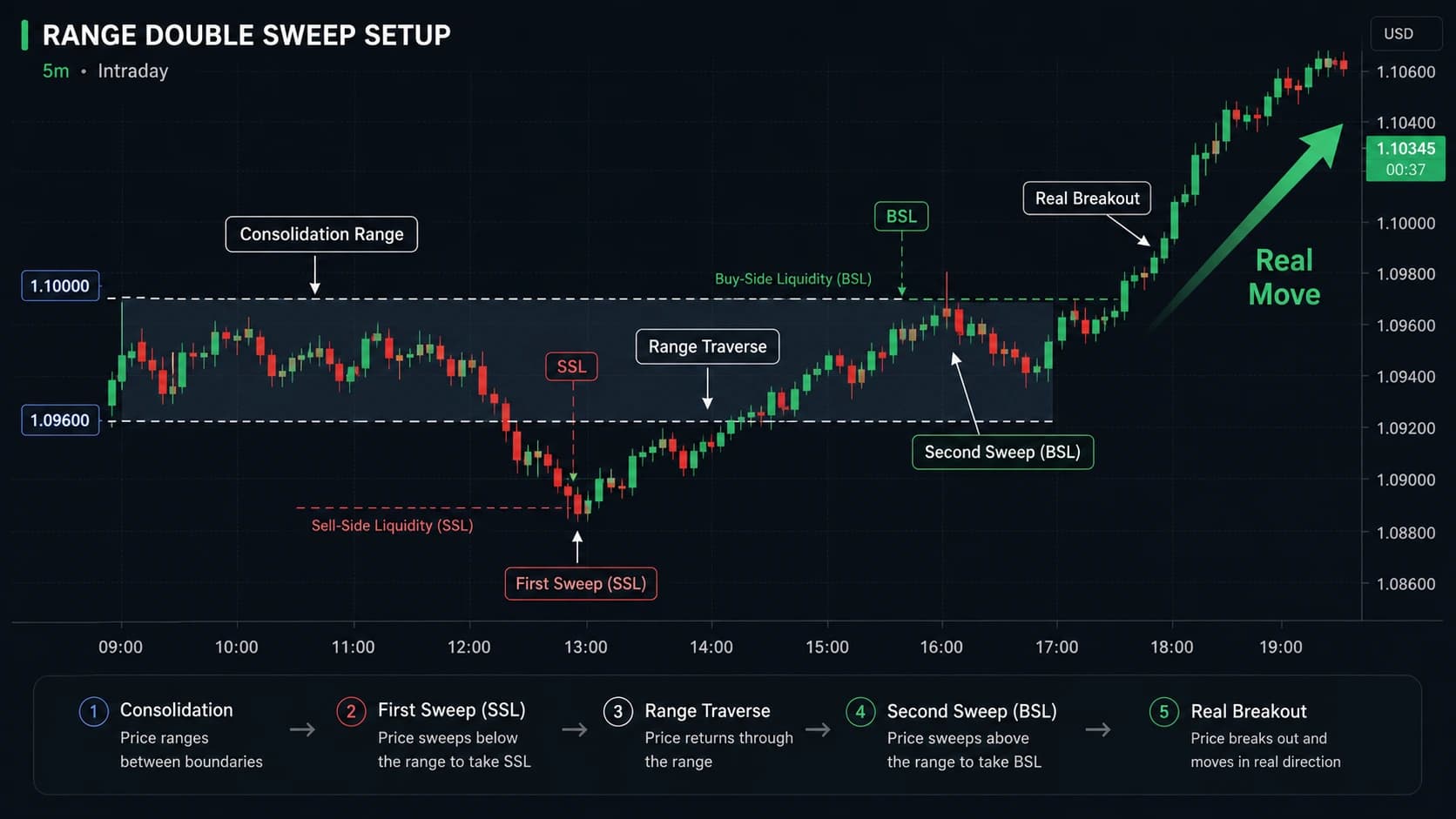
Every genuine BOS in an uptrend is preceded by an SSL sweep at the swing low from which the BOS originates. The sequence is:
- Price forms a swing low (SSL pools below it)
- Institutions sweep the SSL briefly
- With SSL collected, price reverses and breaks above the prior swing high — BOS confirmed
Understanding this sequence means you're never surprised by a "false breakdown" before a BOS. The brief violation of the swing low is not a breakdown — it's the fueling mechanism for the BOS that follows.
Inducement — The Sweep Before the Real Sweep
Inducement is a deliberate smaller liquidity sweep designed to trap early SMC traders before the actual sweep occurs. The first sweep of a session is often inducement — it triggers the stops of breakout traders and the early entries of SMC traders, creating liquidity for the second, larger institutional sweep.
How to avoid inducement traps:
- Always check whether the sweep is of an external structural level (major swing) or an internal level (minor pullback swing)
- The first sweep of a session is often inducement — treat it with skepticism
- Require the higher timeframe bias to align perfectly before acting on any sweep
Warning: In periods of high institutional activity — around economic data releases, Fed announcements, or market open volatility — inducement patterns become particularly aggressive. Reduce position sizing by 50% on days with major macro events.
Part 9: Eight Common Liquidity Sweep Mistakes and Exact Fixes
Mistake 1 — Entering During the Sweep (Not After)
Price breaks below support during a sell-side sweep. The trader, seeing the breakdown, goes short. Price immediately reverses upward.
The fix: The sweep is not the entry — it is the signal that an entry is coming. During the sweep, do nothing. Watch. After the sweep closes back inside the range and the lower timeframe CHoCH confirms, that is your entry.
Mistake 2 — Fading Every Wick as a Sweep
Treating every minor wick beyond a level as a liquidity sweep.
The fix: Apply the volume filter. For US stocks, a liquidity sweep requires the sweep candle's volume to be meaningfully above the 20-period average. A wick on thin, below-average volume is likely noise, not an institutional sweep.
Mistake 3 — Ignoring Higher Timeframe Trend
Entering a bullish sweep trade in a bearish daily trend.
The fix: Before trading any sweep, identify the daily trend. Only trade sweep setups that align with the daily structure.
Mistake 4 — Placing Stops at the Level, Not Below the Wick
Stop placed exactly at the swing low that was swept. A second, smaller sweep touches the swing low and triggers the stop — then price reverses upward as expected.
The fix: Stop goes below the wick extreme of the sweep candle plus an ATR buffer.
Mistake 5 — Trading Every Level Regardless of Significance
The fix: Only mark liquidity levels that are clearly and obviously significant — visible without zooming in, visible to any trader looking at the chart. Focus exclusively on equal highs/lows, major swing points, prior day/week highs and lows, and round numbers.
Mistake 6 — Confusing a Liquidity Run for a Sweep
Entering a short trade after what appears to be a BSL sweep above equal highs. Price spikes above, pauses briefly, and the trader enters short expecting the reversal. But price was actually breaking out with consolidation above the level.
The fix: Apply the acceptance vs. rejection framework. After the break of the level, watch for 3–5 candles. Is price closing back inside (rejection/sweep) or continuing to close at or above the broken level (acceptance/breakout)?
Mistake 7 — Trading Sweeps Around Earnings and News Events
The fix: Avoid trading any sweep that occurs within 30–60 minutes of a major news event. Wait for the post-news volatility to settle and genuine structure to form before identifying and trading liquidity sweeps.
Mistake 8 — Not Tracking Which Levels Have Been Swept
The fix: Mark swept levels after each trade. A level that was swept yesterday and produced a 200-point reversal is no longer a fresh liquidity pool. Track which levels are fresh (unswept) and which are consumed (swept). Fresh levels are your priority.
Part 10: Building a Liquidity Sweep Trading Routine
Pre-Market (7:00–9:15 AM ET)
Liquidity mapping (20 minutes):
- Mark prior day's high (PDH) and prior day's low (PDL) — primary sweep targets for today's session
- Mark any equal highs or equal lows from the past 5–10 sessions
- Note the daily trend direction
Entry level pre-marking: For each high-priority sweep target, pre-mark: the liquidity level, the OB or FVG zone that will be the entry zone after the sweep, the stop level (below the swing low with ATR buffer), and the target (next opposing liquidity pool). Set price alerts at each liquidity level.
Session Execution (9:30–11:00 AM ET)
9:30–9:45 AM: Watch without entering. Observe which liquidity level price moves toward first.
At the sweep: Watch the candle close. Does it close back inside? Volume spike and fade? Speed of return?
Post-sweep (10:00–10:30 AM): If sweep confirmed, drop to 15-minute chart. Wait for CHoCH. Enter on the CHoCH candle close.
Trade management: Set stop below the sweep wick extreme. Set target at the next opposing liquidity. Take partial profit at 1:1 and move stop to breakeven.
FAQ
Q: What is a liquidity sweep in SMC trading? A liquidity sweep is a deliberate price move beyond a key level — a swing high, swing low, or equal highs/lows — that triggers the stop loss orders and pending orders clustered there, providing the institutional order flow needed for large position entries. After collecting the liquidity, price reverses sharply in the opposite direction. The sweep itself is not traded — the reversal that follows the sweep, confirmed by a lower timeframe structure shift, is the entry.
Q: What is the difference between buy-side and sell-side liquidity? Buy-side liquidity (BSL) sits above the market — above swing highs and equal highs — consisting of the stop losses of short sellers and the buy stops of breakout traders. Sell-side liquidity (SSL) sits below the market — below swing lows and equal lows — consisting of the stop losses of long traders and the sell stops of breakdown traders. Institutions sweep BSL to fill large sell positions; they sweep SSL to fill large buy positions.
Q: How do I tell the difference between a liquidity sweep and a real breakout? Apply the acceptance vs. rejection framework. A liquidity sweep closes back inside the prior range quickly — within 1–5 candles — and volume spikes during the breach then immediately fades. A genuine breakout closes repeatedly beyond the level, volume remains elevated, and pullbacks are shallow. The key signal: wait for candle closes, not just wicks.
Q: Where should I place my stop loss after a liquidity sweep trade? Below the wick extreme of the sweep candle (for long entries after SSL sweeps), plus an ATR buffer of 0.5–1x the 14-period ATR. The wick extreme is the true invalidation level — if price closes below it, the sweep was the beginning of a genuine breakdown, not a reversal.
Q: What are equal highs and equal lows in liquidity sweep trading? Equal highs are two or more swing peaks at approximately the same price level — appearing as "double top resistance." Equal lows are two or more swing troughs at the same level — appearing as "double bottom support." Both are high-priority liquidity sweep targets because retail traders uniformly place stops just beyond these levels, creating predictable stop clusters.
Q: When is the best time to trade liquidity sweeps in US stocks? The New York AM session (9:30–11:00 AM ET) is the highest-probability window. This is when institutional volume is highest, the AMD cycle's manipulation phase is most active, and sweeps are most decisive and reliable. Sweeps that occur during the lunch session (11:30 AM–1:00 PM ET) are less reliable due to lower volume.
Conclusion
Understanding liquidity sweeps changes everything about how you read a price chart.
The stop-outs that used to feel personal become predictable mechanical events. The "false breakouts" that confused you reveal themselves as systematic liquidity collection.
The three most important principles from this guide:
1. Never enter during the sweep. The sweep is not the trade. It is the setup for the trade. Patience is the entire strategy.
2. Not every wick is a sweep. Apply the five-signal framework rigorously. Only trade sweeps that pass all five filters.
3. Map liquidity before the session, not during it. Pre-mark your levels. Set alerts. Then during the session, execute — don't identify.
Related Articles
- Smart Money Concepts: The Complete Mastery Guide — The complete SMC framework that explains how liquidity sweeps fit within the broader institutional trading system
- SMC Market Structure: BOS, CHoCH and Strong vs Weak Levels — Every genuine BOS is preceded by a liquidity sweep — learn to read the structural events that make sweeps meaningful
- Order Blocks: The Complete Mastery Guide — How to enter at the institutional zone after the sweep confirms the reversal
- Fair Value Gaps: The Complete Mastery Guide — The FVG created after a sweep is one of the cleanest and most reliable entry signals in SMC
- Inducement (IDM): The Complete SMC Guide — Why some sweeps are real reversals and others are traps designed to trap traders who anticipated the sweep
- Accumulation, Manipulation, Distribution (AMD Cycle) — The AMD framework reveals when to expect sweeps and how to distinguish the manipulation sweep from the real move
Disclaimer: This article is for educational purposes only and does not constitute financial or investment advice. Stock trading involves significant risk of loss. Past performance of any trading pattern or strategy does not guarantee future results. Always use proper risk management and only trade with capital you can afford to lose.
Continue Reading