Inducement (IDM): The Complete SMC Trading Guide (2026)
Master inducement (IDM) in SMC trading. Learn what inducement is, every type, how to identify valid vs fake IDM, how to avoid being trapped, and how to trade the real move after the inducement sweep — with step-by-step stock trading examples.
Introduction
You've been right about the direction. Completely right. You analyzed the chart, identified the trend, found a valid entry zone, entered the trade — and got stopped out. Then, within minutes, price moved exactly where you expected it to go.
Without you.
What you experienced was not bad luck. It was not poor analysis. It was inducement — one of the most sophisticated and consistent behavioral patterns in institutional trading, and the concept that sits at the heart of why retail traders lose when their directional read is correct but their timing is off by a matter of minutes.
Inducement (IDM) is the deliberate engineering of a visible, attractive trading setup — a setup that looks valid by every textbook measure — for the explicit purpose of drawing retail traders into positions, collecting their stop losses as liquidity, and then executing the real institutional move in the actual intended direction.
Once you understand inducement at a deep level — what it is, why it works, where it appears, and how to identify every type before being trapped — it transforms from your most frequent source of losses into one of your highest-probability entry signals.
TL;DR — Key Takeaways
- Inducement (IDM) is any market structure or price level that lures FOMO retail traders into premature positions before the real institutional move sweeps their stops and delivers in the true direction
- Inducement is the cause — the setup that attracts retail entries; the liquidity sweep is the effect — the execution of the trap that triggers those stops
- The four primary IDM types: post-BOS pullback trap, post-CHoCH continuation trap, range boundary trap, and multi-layer / double inducement
- Valid inducement must be the first valid pullback within the leg that created the most recent BOS or CHoCH — not just any swing point
- The trade entry is always after the inducement has been swept — at the PD array (OB or FVG) that forms following the sweep, confirmed by a lower timeframe MSS
- Never enter at the first post-BOS pullback — that is the inducement, not the entry
- Stop loss goes beyond the swept inducement extreme — never at the inducement level itself
Part 1: What Is Inducement? The Complete Institutional Explanation
The Fundamental Problem Institutions Have
Every concept in SMC connects to the same foundational reality: institutions are too large to trade like retail traders.
A hedge fund managing $10 billion in assets cannot simply click "buy" and expect to fill its desired position efficiently. The fund needs counterparty volume — sellers willing to transact at the current price level — to fill its buy order without moving the market against itself.
Where does that counterparty volume come from? From retail traders who have been positioned on the wrong side of the trade. From the stop-loss orders of retail traders who entered long too early and are now being stopped out as price drops against them, generating sell volume that the institution buys.
Inducement is the mechanism that creates this retail positioning. It is the deliberate construction of a setup — using price movement — that looks compelling enough to pull retail traders into positions they will subsequently be stopped out of.
The Formal Definition
Inducement (IDM) is any key level, market structure point, or price pattern that is specifically engineered or naturally functions to attract FOMO retail traders into executing trades prematurely — before the real institutional move begins — such that their stop losses become the liquidity that fuels the actual directional delivery.
Inducement vs. Liquidity Sweep — The Crucial Distinction
Inducement is the cause — the setup that attracts retail traders into position, generating the accumulation of stop orders at predictable levels.
The liquidity sweep is the effect — the actual price movement that triggers those stop orders, collecting the accumulated liquidity.
The sequence is: inducement creates the conditions → retail traders enter and place stops → the sweep triggers those stops → institutions fill their real orders → the real directional move begins.
Pro Tip: The most consistent anti-inducement habit you can develop is never entering the first post-BOS pullback. Always treat it as a potential inducement until the sweep has occurred and a lower timeframe CHoCH confirms the real continuation. This single discipline eliminates the vast majority of inducement losses.
Part 2: The Four Primary Types of Inducement
Type 1 — Post-BOS Pullback Inducement (The Most Common Trap)
This is the most frequently encountered and most costly form of inducement.
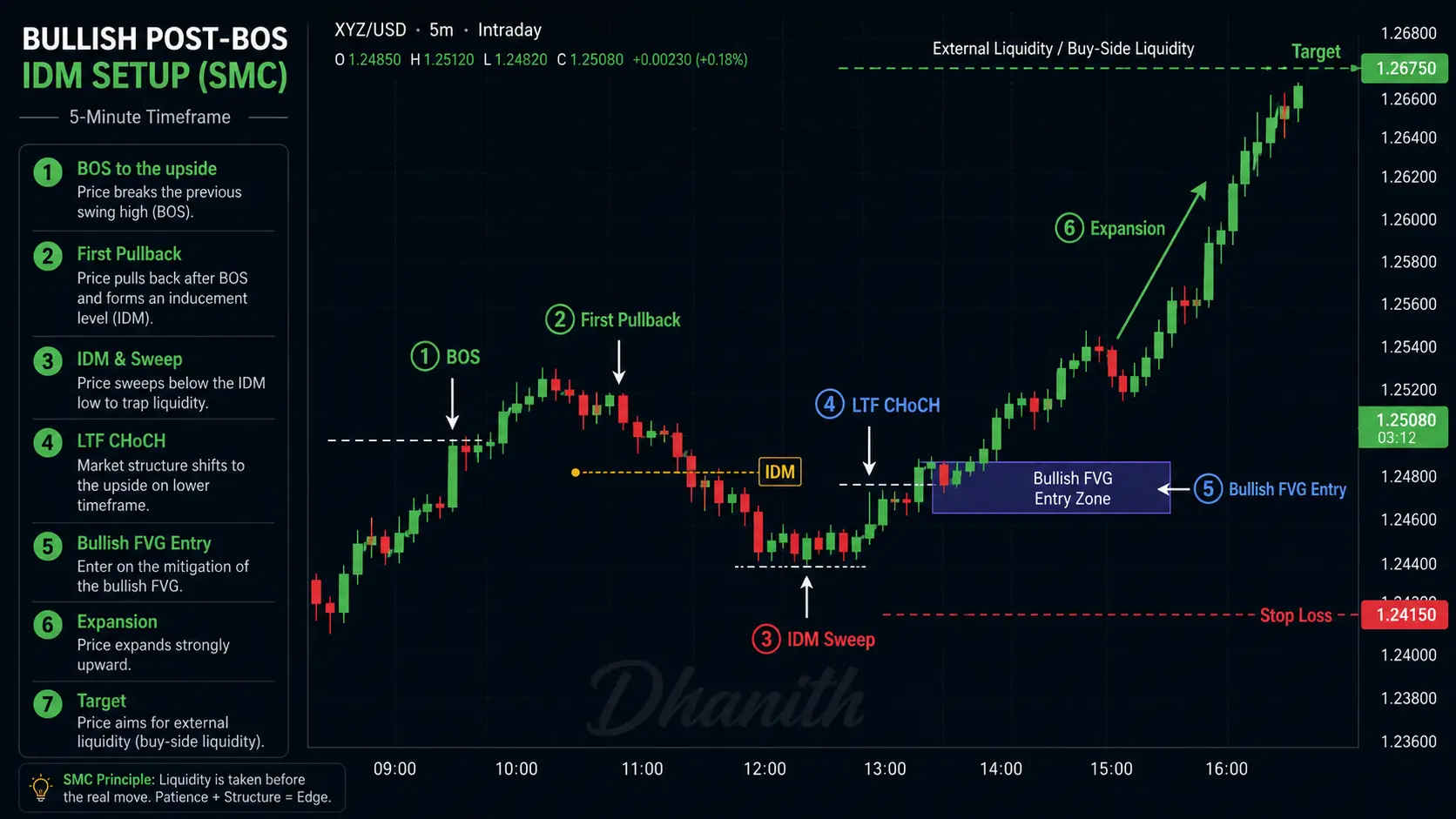
The setup: Price is in a confirmed uptrend. A bullish BOS occurs. Retail traders, recognizing the BOS, look for the first pullback to enter long — exactly as their SMC education has taught them. The first pullback forms. A swing low appears. An order block may be visible at the bottom of the pullback. The setup looks exactly like a valid bullish continuation entry.
The trap: Price drops below the first pullback's swing low — triggering the stop losses of traders who entered long at the pullback. This sweep below the first swing low is the inducement sweep. After the sweep, price reverses sharply upward, continuing the bullish trend — excluding the traders who were stopped out.
The correct approach:
- Identify the BOS
- Mark the first post-BOS pullback as the inducement level — not the entry
- Wait for price to sweep below the inducement level
- Confirm the sweep with a lower timeframe bullish CHoCH
- Enter at the PD array (OB or FVG) formed after the sweep
- Stop below the swept inducement extreme
Type 2 — Post-CHoCH Continuation Trap (The Reversal Trap)
This is particularly dangerous because it targets traders at the moment of a structural reversal — when emotional conviction is highest.
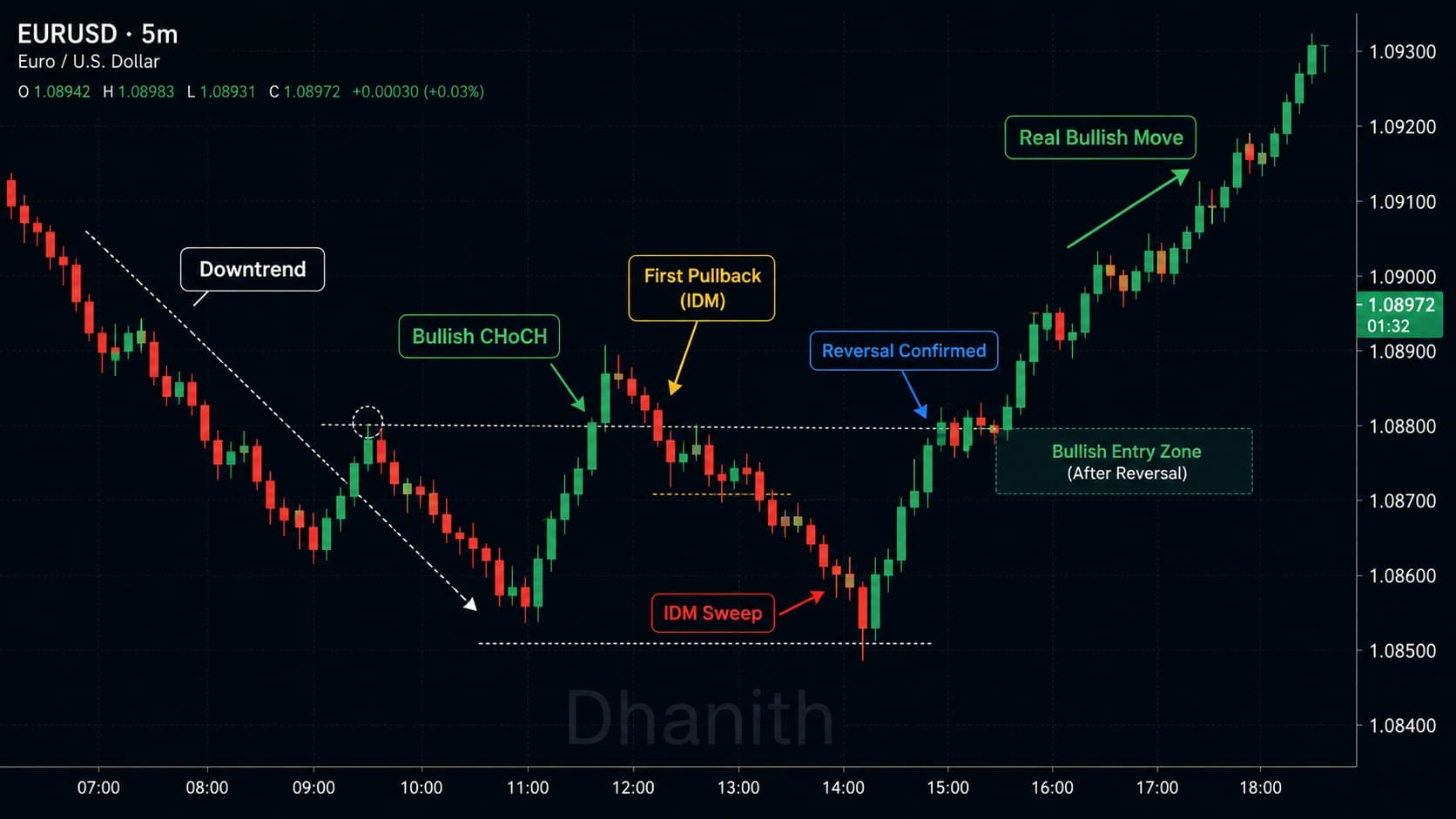
The setup: Price has been in a downtrend. A bullish CHoCH appears — price breaks above a significant Lower High. Traders believe the reversal is real and enter long, placing stops below the CHoCH's swing low.
The trap: Price pulls back below the CHoCH swing low, triggering those stops. Many traders even reverse and enter short, expecting the downtrend to continue. Price then aggressively reverses upward — the CHoCH was real but the first pullback after it was inducement.
The correct approach: Recognize the CHoCH as a genuine structural signal — but treat the first pullback as potential inducement. Mark the CHoCH swing low as the inducement level. Wait for the sweep. Confirm with lower timeframe CHoCH in the bullish direction. Enter at the post-sweep PD array.
Type 3 — Range Boundary Trap (The Consolidation Trap)
This form of inducement operates within a defined trading range, targeting the predictable behavior of range traders.
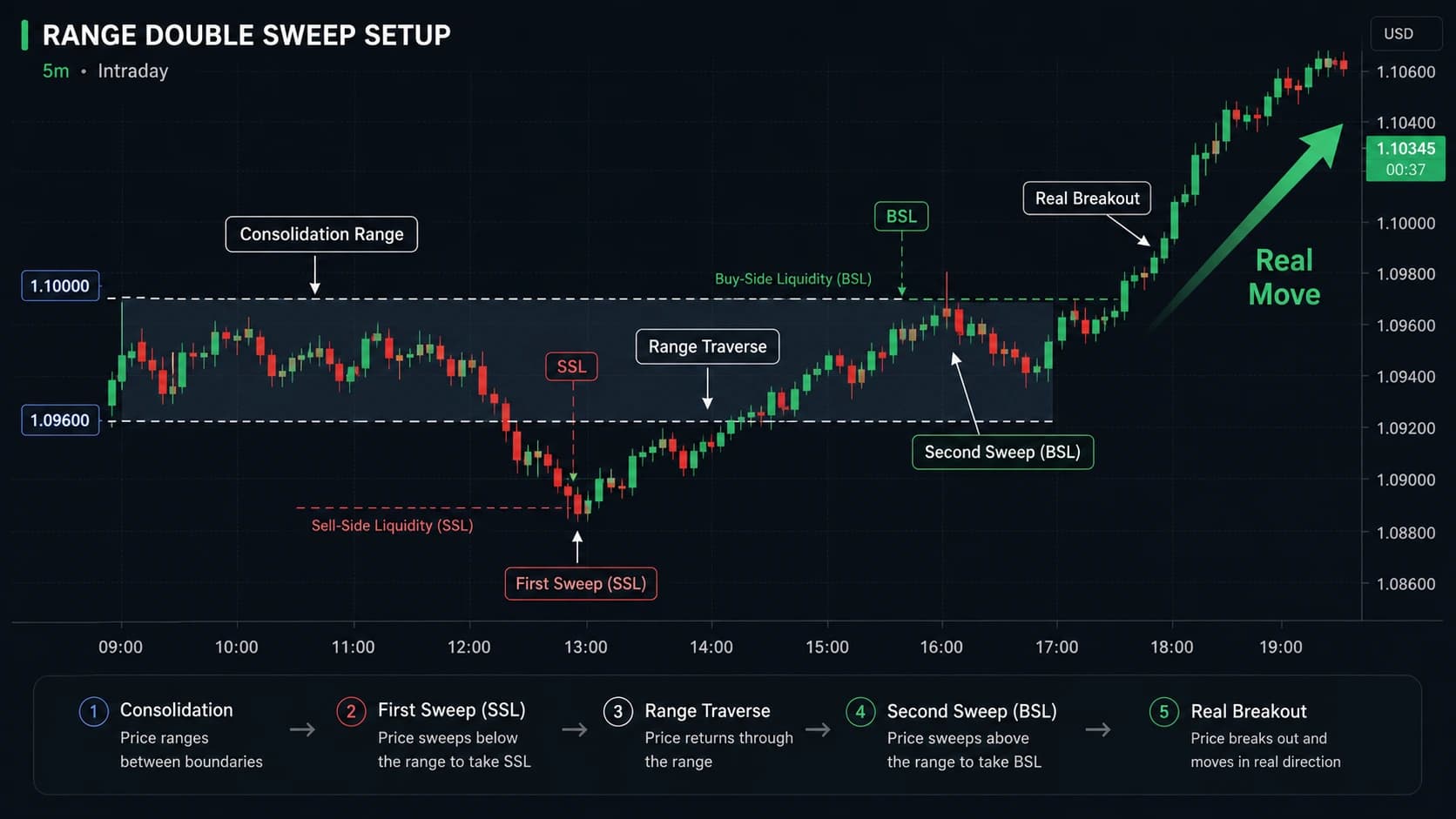
Phase 1 — Single boundary sweep: Price breaks below the support floor, triggering long stops. Breakout sellers enter short. Price quickly reverses back inside the range. The range floor served as an inducement — it collected the sell-side liquidity for the subsequent move.
Phase 2 — Double boundary sweep: In more sophisticated inducement, price traverses the range and sweeps the opposite boundary before the real move begins. Both sides of the range are swept — collecting both the SSL (below support) and the BSL (above resistance) — before the real directional move delivers.
The correct approach: Mark the range floor and ceiling as the expected inducement targets — not entry levels. Wait for a sweep of at least one boundary, preferably both. After the second sweep, confirm the reversal with a lower timeframe CHoCH. Enter at the post-sweep PD array inside or near the range.
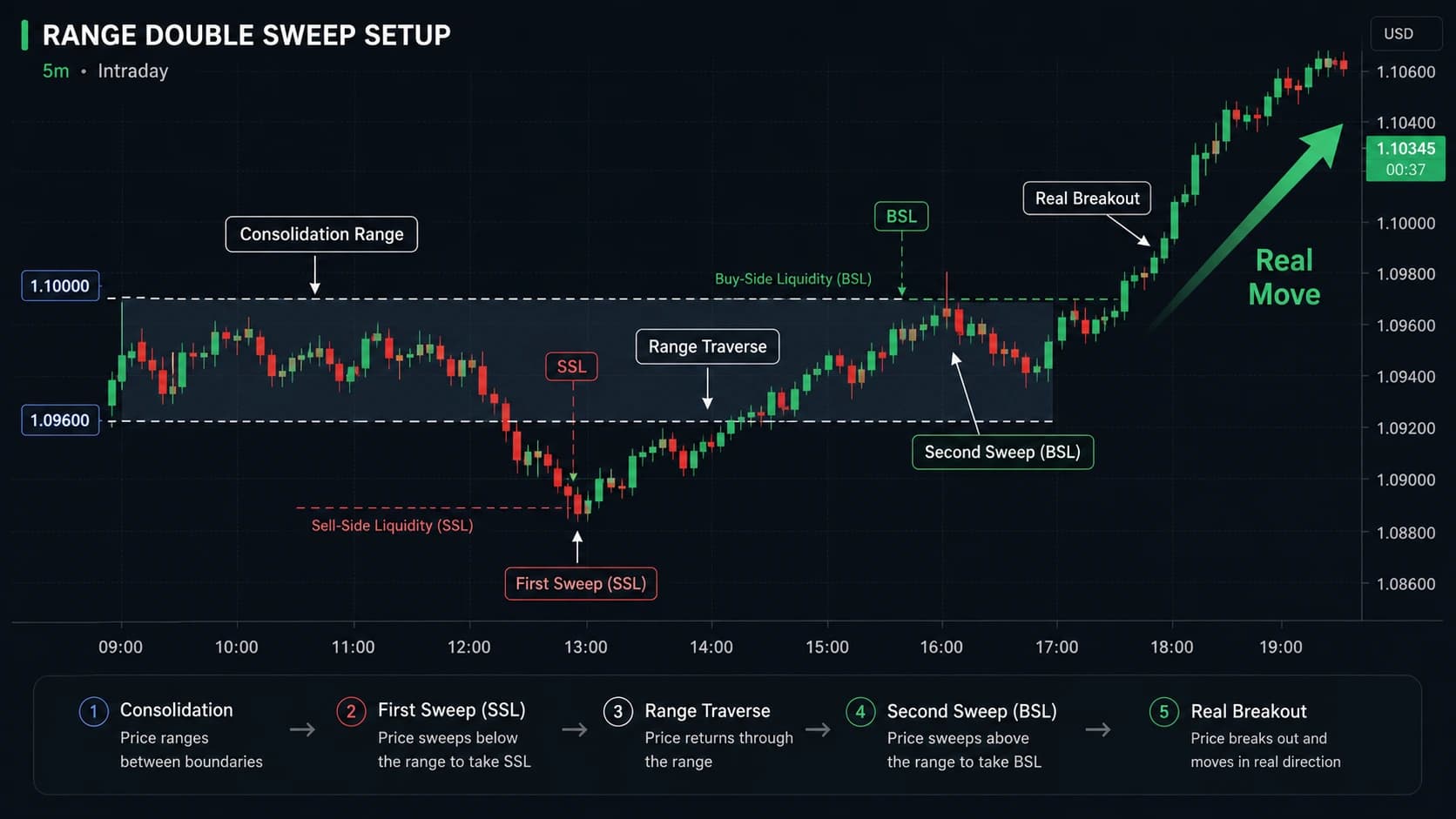
Type 4 — Multi-Layer / Double Inducement (The Advanced Trap)
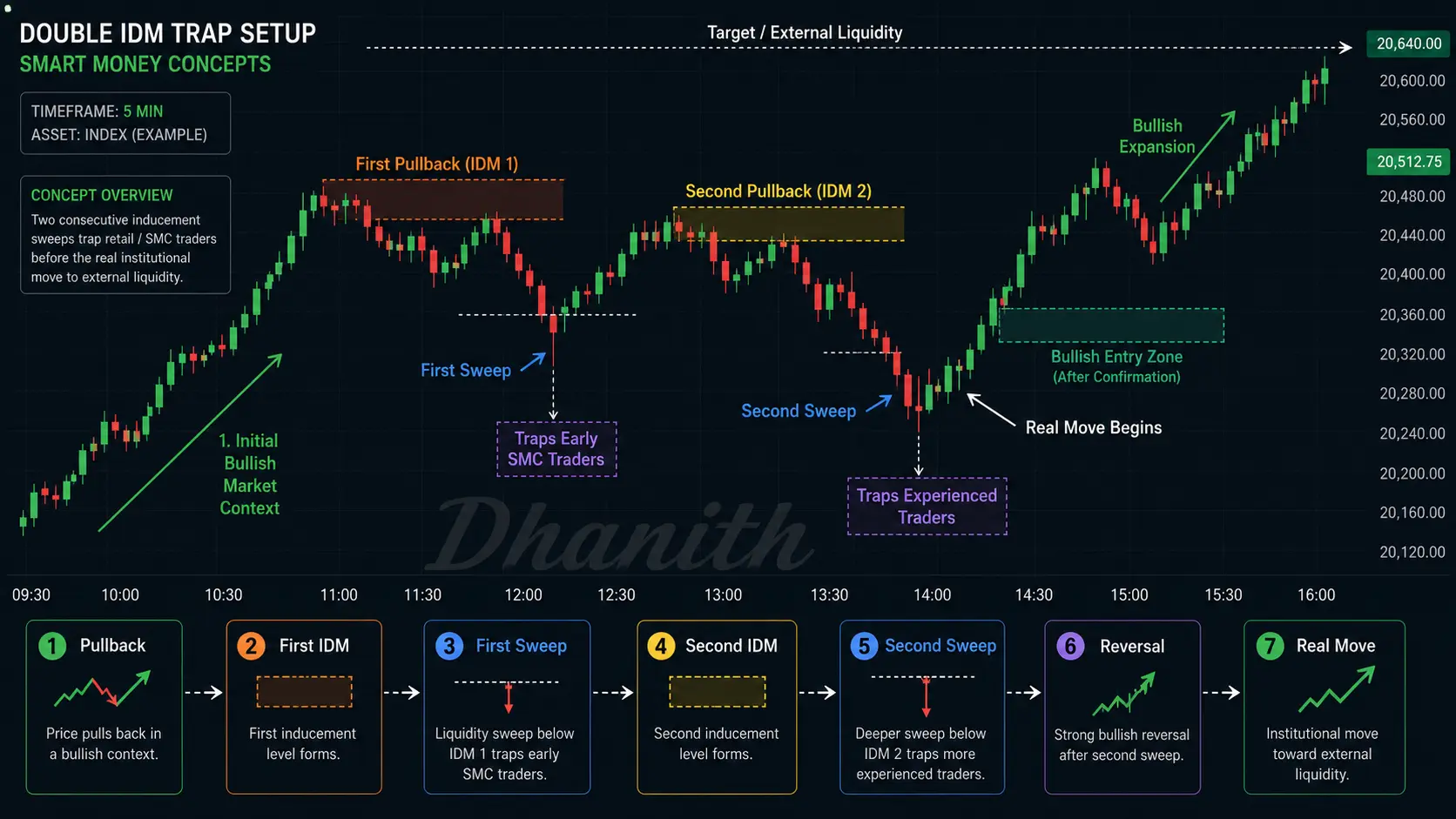
This is the most sophisticated form of inducement, specifically designed to trap traders who have already learned to avoid basic inducement.
The mechanism: Smart money creates a double inducement — two consecutive layers of fake structural setups, each one sweeping the stops of traders who entered at the previous inducement level.
The sequence:
- BOS occurs
- First pullback forms — most retail traders enter here (inducement Level 1)
- Price sweeps below Level 1 — trained SMC traders who waited for the sweep now enter (inducement Level 2 in formation)
- Price sweeps below Level 2 — both groups are now stopped out
- The real move begins from below Level 2
How to identify double inducement: The sweep of Level 1 is weak — price barely violates the level, the reversal is tentative, volume is moderate. A second pullback forms just above the Level 1 sweep area. When Level 2 is swept aggressively with strong volume, that is the real inducement completion.
Warning: Double and triple inducement is increasingly common in 2026 on US equity markets, particularly around major economic data releases. During high-impact news days, apply extra skepticism to any post-sweep entry — treat every first sweep as potential inducement and wait for the second sweep before considering entry.
Part 3: How to Identify Valid Inducement Levels — The Step-by-Step Process
The Valid Inducement Rule
A valid inducement level is the swing high or low of the first valid pullback within the leg that created the most recent significant BOS or CHoCH.
Step-by-Step Identification Process
Step 1 — Identify the most recent significant BOS: The BOS must be a meaningful structural break — not an internal minor swing.
Step 2 — Find the first pullback within the BOS leg: Look back at the displacement leg that caused the BOS. The first retracement creates a swing low (for bullish BOS) or swing high (for bearish BOS). That swing point is the inducement level (IDM).
Step 3 — Mark the inducement level: Draw a horizontal line at the swing low of the first pullback (bullish context) or the swing high (bearish context).
Step 4 — Wait for the sweep: Do nothing until price returns to the inducement level and sweeps it — a wick or close beyond the level, not just a touch.
Step 5 — Confirm the reversal: After the IDM sweep, drop to the lower timeframe (15-minute or 5-minute) and wait for a bullish CHoCH (bullish context) or bearish CHoCH (bearish context).
Step 6 — Enter at the post-sweep PD array: The sweep and LTF CHoCH create a displacement candle. This displacement leaves an order block or fair value gap. Enter at the CE (50% midpoint) of the FVG or at the OB zone.
Step 7 — Stop and target: Stop beyond the swept inducement extreme. Target the next draw on liquidity — the previous BOS swing high (bullish) or next structural low (bearish).
Part 4: Inducement and Market Structure — The Deep Connection
Inducement in Bullish Structure (HH/HL Uptrend)
In a confirmed uptrend, the following structural pattern repeats:
- Higher Low (HL) forms — price rally begins
- Prior Higher High broken — BOS confirmed
- First pullback forms — this pullback's swing low = Inducement Level
- IDM sweep occurs — retail longs stopped out
- Lower timeframe bullish CHoCH confirms reversal
- Next BOS leg begins — new Higher High forms
- Next pullback's swing low = new Inducement Level
Every iteration is an opportunity. The IDM provides the structural precision to know exactly which level will be swept before the next BOS leg.
The Inducement–Valid Pullback Progression
Inducement level: The first post-BOS pullback. The level attracts FOMO entries and will be swept.
Valid pullback: After the IDM has been swept and the real BOS leg has begun, the next pullback produces a genuine higher low (in uptrends). This is the valid entry zone — not a trap.
- If you see the first pullback after a BOS: mark it as IDM, wait for the sweep
- If you see the second pullback after the IDM has already been swept: this is likely a valid entry zone
Part 5: Inducement Across Every Timeframe — The Fractal Nature of IDM
Like all SMC concepts, inducement is fractal — it operates at every timeframe simultaneously. A setup that appears valid on a lower timeframe can itself be inducement within the context of a higher timeframe structure.
The most advanced IDM insight: a setup that is perfectly valid on the 15-minute chart — with a proper BOS, clean pullback, and visible OB — can itself be inducement within the context of the 1-hour or 4-hour structure.
The rule: Always check the higher timeframe structure before acting on any lower timeframe setup. A valid-looking 15-minute long setup within a 4-hour bearish IDM zone is the 4-hour inducement — not a real opportunity.
Part 6: Four Inducement-Based Trading Strategies
Strategy 1 — The Post-BOS IDM Sweep Entry (Core Strategy)
Full execution sequence:
- Identify the daily trend and the most recent daily BOS
- Mark the first post-BOS pullback's swing low (bullish) or swing high (bearish) as the IDM level
- As price approaches the IDM level, switch to the 15-minute chart
- Watch for the IDM sweep with a volume spike followed by immediate fade
- After the sweep, watch for the first 15-minute bullish CHoCH
- Enter at the FVG's CE with a limit order
- Stop below the IDM sweep's wick extreme
- Target: the next draw on liquidity
Risk-reward typical range: 2:1 to 4:1 when stop is placed correctly and target is the structural liquidity pool.
Strategy 2 — The CHoCH + IDM Reversal Entry (Trend Change Strategy)
Execution sequence:
- Identify a bearish downtrend (LH/LL structure)
- A bullish CHoCH appears — do NOT enter immediately
- Mark the CHoCH's first pullback low as the IDM level
- Wait for price to sweep below this IDM level
- After the sweep, confirm with a 5-minute or 15-minute bullish CHoCH
- Enter at the post-sweep PD array
- Stop below the IDM sweep's wick extreme
- Target: the next significant BSL above
Strategy 3 — The Range Double Sweep Entry (Range Breakout Strategy)
Execution sequence:
- Identify a clear accumulation range with well-defined ceiling and floor
- Mark the equal highs (BSL above) and equal lows (SSL below) as both IDM levels
- Determine higher timeframe bias
- Wait for the SSL sweep (below range floor for bullish setups)
- After the sweep, confirm with a 15-minute bullish CHoCH
- Enter at the post-sweep bullish PD array
- Stop below the SSL sweep's wick extreme
- Target: the BSL above (range ceiling) and potentially the liquidity beyond
Strategy 4 — The Multi-Timeframe IDM Cascade Entry (Advanced Strategy)
Execution sequence:
- Daily chart: identify the daily IDM level (first post-BOS pullback)
- 4-Hour chart: find the 4-hour IDM level that aligns with the daily IDM zone
- Set alerts at the daily IDM level
- When both the daily and 4-hour IDM levels are swept simultaneously, confirm with a 15-minute bullish CHoCH and volume confirmation
- Enter at the 15-minute FVG or OB within the convergence zone
- Stop below the deepest swept IDM level extreme
- First target: 4-hour liquidity pool above. Second target: daily structural liquidity above
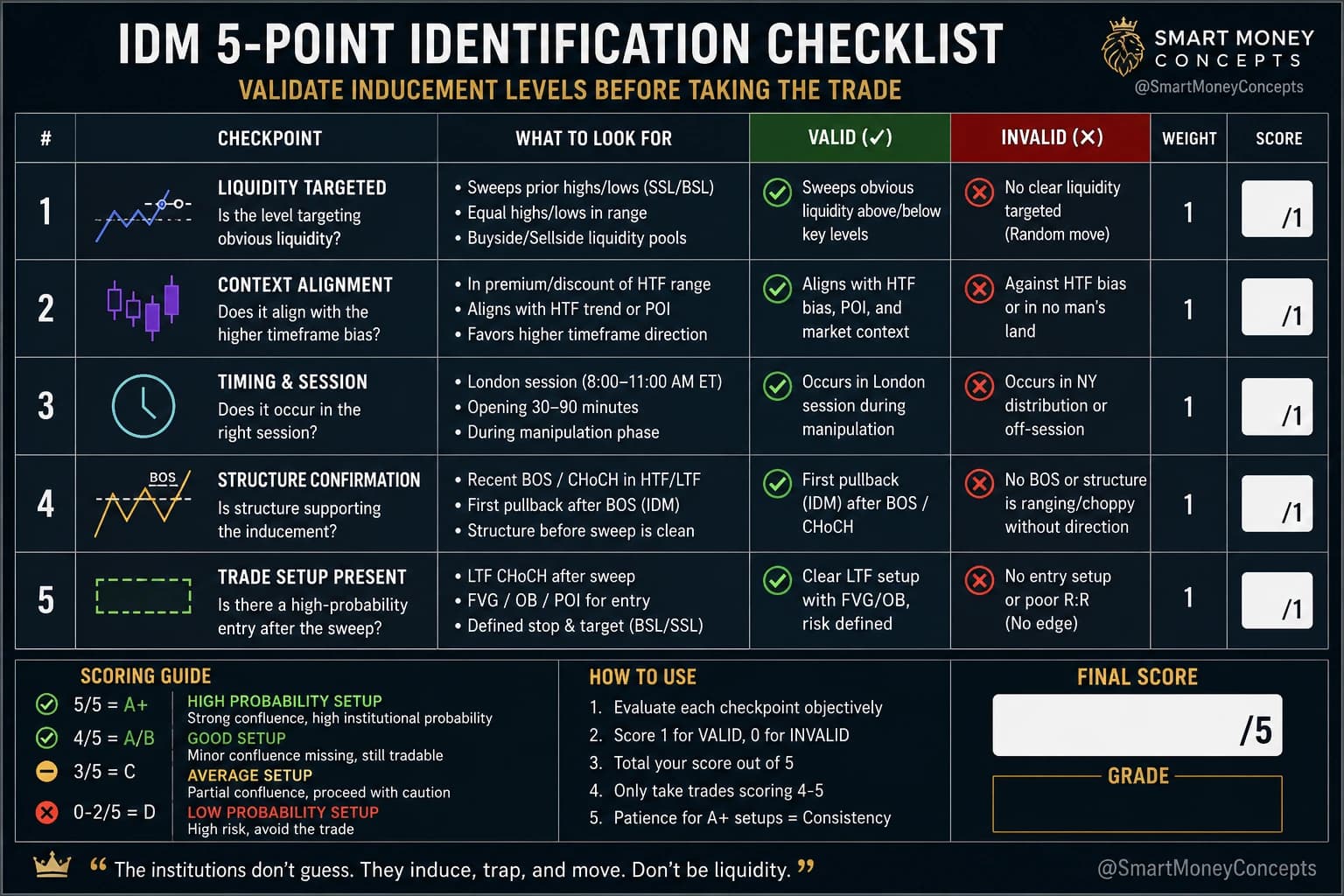
Part 7: Identifying Inducement — The 5-Point Checklist
Before treating any price level as a valid IDM and acting on its sweep, run through this checklist:
Check 1 — Is it the FIRST valid pullback? Only the first significant pullback after a BOS or CHoCH constitutes a valid inducement level.
Check 2 — Is the inducement level significant to retail traders? Would a typical retail trader using conventional technical analysis see this level as an entry point? Valid inducement is visible and obvious.
Check 3 — Does the higher timeframe bias support the expected direction? After the IDM sweep, which direction should price move? Does that direction align with the weekly and daily trend?
Check 4 — Is there a quality PD array beyond the IDM level? Is there a valid order block or FVG below the IDM level (for bullish setups) that will catch the sweep and create the reversal?
Check 5 — Is the premium and discount zone correct? A bullish IDM sweep should drive price into the discount zone. If the IDM sweep would only push price to equilibrium or above it, the discount positioning is weak.
Part 8: Inducement in the Complete SMC Framework
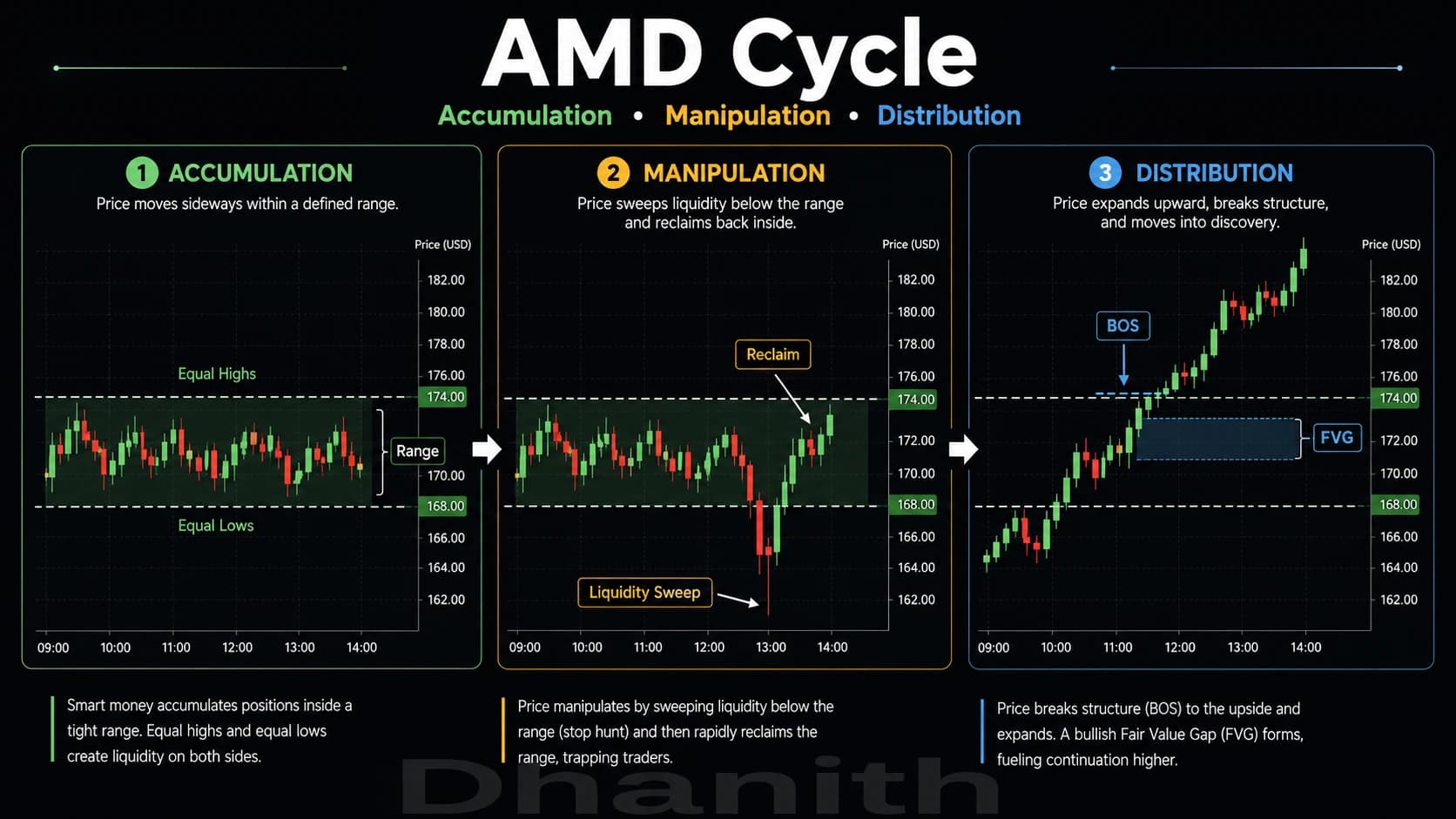
Inducement and the AMD Cycle
The Manipulation phase of the AMD cycle is inducement at the session level. The Judas Swing is the manipulation-phase inducement sweep — the deliberate false move that sweeps the accumulation range's liquidity before the distribution phase begins.
The AMD cycle provides the time context for inducement; IDM provides the structural level that will be targeted.
Inducement and Order Blocks
The OB quality hierarchy for IDM:
| OB Location | Validity | Action |
|---|---|---|
| OB at first post-BOS pullback (the IDM) | Inducement — will be swept | Do NOT enter; mark as IDM level |
| OB formed by displacement AFTER the IDM sweep | Valid institutional OB | Enter here with full confidence |
| OB at second pullback after IDM is cleared | Valid entry zone | Enter with standard criteria |
Inducement and Fair Value Gaps
FVG as inducement: A bullish FVG at the first post-BOS pullback creates an obvious entry signal for retail traders. The IDM sweep takes price below the FVG, triggering those stops, before reversing upward.
FVG after the IDM sweep: The displacement candle that occurs after the IDM sweep creates a high-quality bullish FVG. This is the real entry zone.
Part 9: Inducement for US Stock Traders — Specific Considerations
Session-Based IDM Patterns
Opening 30 Minutes (9:30–10:00 AM ET): The opening session is the highest-frequency inducement window for US stocks. Retail traders who analyze the pre-market structure and identify "obvious" BOS pullback entries are systematically trapped during the opening minutes.
10:00–11:00 AM ET (Post-IDM Distribution): After the opening IDM sweep (typically completing by 10:00 AM), the distribution phase begins. This 60-minute window is the primary entry window for IDM-based trades on US stocks.
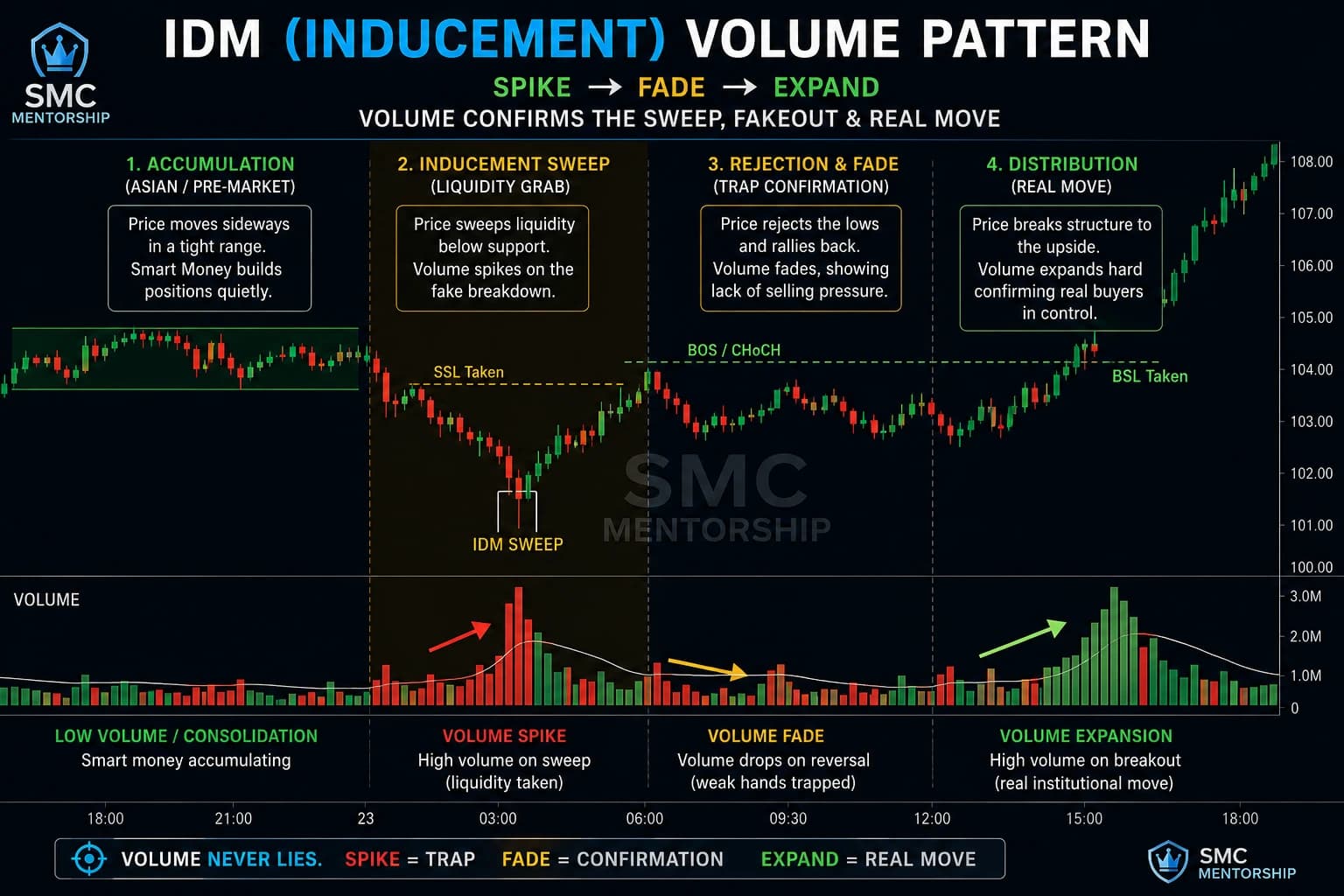
Volume as IDM Confirmation for Stocks
Volume during the IDM sweep: Volume should spike as price moves through the IDM level — confirming that stop orders are being triggered.
Volume after the sweep: Volume should fade immediately after the sweep candle. This confirms that the selling pressure from triggered stops is exhausted and institutional buyers are absorbing.
Volume on the first distribution candle: When the real institutional move begins, the distribution candle should show expanding volume — confirming institutional participation.
Dhanith Trading Journal
Track every trade. Find your real edge.
Log your setups, grade your entries, and review your trading patterns — all in one place. The journal built for serious SMC traders.
Part 10: Common Inducement Mistakes and Exact Fixes
Mistake 1 — Entering at the First Post-BOS Pullback
The fix: Memorize one rule and never break it: the first pullback after a BOS is the inducement, not the entry. Mark it as IDM. Wait for the sweep. Enter at the post-sweep PD array.
Mistake 2 — Treating Every Swing Point as Inducement
The fix: Valid inducement is specifically the first pullback after a significant structural event (BOS or CHoCH). Apply the 5-point IDM checklist before marking any level as inducement. Only mark one inducement level per structural leg.
Mistake 3 — Not Requiring Lower Timeframe Confirmation After the Sweep
The fix: The IDM sweep is not the entry trigger — it is the signal that the entry is approaching. After the sweep, wait for the 15-minute or 5-minute bullish CHoCH before placing the trade.
Mistake 4 — Placing Stops at the IDM Level (Inside the Trap)
The fix: Stop goes beyond the swept IDM extreme — below the wick of the sweep candle for bullish trades, above the wick for bearish — with an ATR buffer.
Mistake 5 — Not Updating the IDM Level as Structure Evolves
The fix: After every BOS, identify the new IDM level from the new first pullback. When the next BOS occurs, update the IDM level. Archive or delete old IDM levels that have already been swept.
Mistake 6 — Ignoring the Higher Timeframe Context
The fix: Before acting on any IDM setup, check the daily and 4-hour charts. Only trade IDM setups that align with the daily bias.
Mistake 7 — Trading Inducement Sweeps During News Events
The fix: Mark high-impact economic events on your calendar before every session. During the 30 minutes surrounding any major news release, treat all price movements — including apparent IDM sweeps — as unreliable.
FAQ
Q: What is inducement in SMC trading? Inducement (IDM) in SMC is any market structure or price level engineered to attract retail traders into premature positions before the real institutional move sweeps their stop losses and delivers in the true direction. It is specifically the first valid pullback after a BOS or CHoCH — the level that looks like an entry but is actually the trap. After the inducement is swept and confirmed by a lower timeframe CHoCH, the entry opportunity appears at the first PD array in the real move direction.
Q: What is the difference between inducement and a liquidity sweep? Inducement is the cause — the setup that draws retail traders into positions. The liquidity sweep is the effect — the price movement that triggers those stop orders. Inducement creates the conditions; the sweep executes the trap. Trading after the sweep — once the inducement has completed — is where the highest-probability entries exist.
Q: How do I identify a valid inducement level? A valid IDM level is the swing high or low of the first valid pullback within the leg that created the most recent significant BOS or CHoCH. It must be clearly visible to retail traders, aligned with the higher timeframe bias direction for the expected post-sweep move, and there should be a quality PD array beyond it that will catch the sweep and create the reversal.
Q: When should I enter after an inducement sweep? Never enter during the sweep itself — enter after it completes and the lower timeframe confirms the reversal. Wait for: (1) the sweep to close back beyond the IDM level, (2) a lower timeframe CHoCH or MSS to confirm the directional shift, and (3) a clean PD array (FVG or OB) to form during the initial post-sweep displacement.
Q: Is the first pullback after a BOS always inducement? In most institutional market conditions, yes — the first post-BOS pullback functions as inducement and will be swept before the real trend continuation. In extremely strong trending markets, price occasionally does not sweep the first pullback and instead uses it as a genuine valid entry. Apply the 5-point checklist and require LTF CHoCH confirmation to distinguish between the two scenarios.
Conclusion
Inducement is the concept that separates traders who consistently get stopped out before the real move from traders who enter at the real move with tight stops and clear targets.
The three most important principles from this guide:
1. The first pullback is always suspect. After any BOS or CHoCH, treat the first pullback as inducement until proven otherwise. Wait for the sweep before planning entry.
2. The sweep is not the entry — it is the signal. After the sweep, wait for lower timeframe CHoCH confirmation and a clean PD array. Those 2–5 minutes are the most important patience test in your trading.
3. Always check higher timeframe context. A valid-looking IDM setup on the 15-minute chart can be inducement within the daily structure. The daily bias filters everything.
Related Articles
- Smart Money Concepts: The Complete Mastery Guide — The full SMC framework that explains the institutional logic behind why inducement traps are engineered in the first place
- SMC Market Structure: BOS, CHoCH and Strong vs Weak Levels — Inducement always targets the first pullback after a BOS or CHoCH — understanding structure is essential to identifying IDM levels
- Liquidity Sweeps: The Complete Mastery Guide — The inducement sweep is a liquidity sweep — learn the full mechanics of how stop collection works
- Order Blocks: The Complete Mastery Guide — The valid entry after an IDM sweep occurs at the post-sweep order block, not at the IDM level itself
- Accumulation, Manipulation, Distribution (AMD Cycle) — The AMD manipulation phase is session-level inducement — the same concept applied to the daily trading cycle
- SMC Killzones: The Complete Trading Guide — Inducement sweeps are most aggressive during the opening 30 minutes of the NY session — timing is critical to avoiding traps
Disclaimer: This article is for educational purposes only and does not constitute financial or investment advice. Stock trading involves significant risk of loss. Past performance does not guarantee future results. Always use proper risk management and only trade with capital you can afford to lose.
Continue Reading