Premium and Discount Zones: The Complete SMC Trading Guide (2026)
Master premium and discount zones in SMC trading. Learn equilibrium, Fibonacci dealing ranges, OTE (62–79%), PD arrays, multi-timeframe application, and how to only buy cheap and sell expensive — with stock trading examples.
Introduction
Most retail traders know they should "buy low and sell high." Every piece of beginner trading advice says the same thing. Yet the majority of retail traders consistently do the exact opposite — they buy when price is expensive (near swing highs, at breakout points) and sell when it is cheap (near swing lows, during panic selloffs).
This is not a psychological failure. It is a structural one.
Without a precise, objective framework for measuring whether price is currently cheap or expensive relative to a defined range, every entry is guesswork.
Premium and discount zones solve this problem permanently. They give you an objective, Fibonacci-based framework for answering the most important question in trading: Is price expensive or cheap right now, and what should I be doing here?
The answer is always one of three things: price is in the premium zone (expensive — look to sell), price is in the discount zone (cheap — look to buy), or price is at equilibrium (fair value — wait for it to move to one side before acting).
TL;DR — Key Takeaways
- Premium zone = the upper half of any price range (above 50% equilibrium) — institutions sell here
- Discount zone = the lower half of any price range (below 50% equilibrium) — institutions buy here
- Equilibrium (50%) = fair value — the midpoint of any range — not a trading signal, but a zone divider
- Identify zones using a Fibonacci tool: draw from swing low to swing high (bullish) or swing high to swing low (bearish) — the 50% level marks equilibrium
- Optimal Trade Entry (OTE) sits between 62% and 79% retracement — the highest-probability sub-zone within discount (bullish) or premium (bearish)
- The "dealing range" must be defined by a significant structural event — a BOS or CHoCH — not random price movement
- PD arrays (OBs, FVGs, breakers) inside the correct premium/discount zone multiply probability dramatically
- Never buy in premium or sell in discount — this single filter eliminates a massive percentage of low-probability trades
Part 1: The Core Concept — Why Price Is Either Cheap or Expensive
The Institutional Value Framework
Institutions do not enter trades randomly. They have one consistent objective in all markets: buy below fair value and sell above fair value.
The challenge for retail traders is that "fair value" is never displayed on a price chart. Without this information, entry timing is essentially guesswork. Smart Money Concepts — specifically the premium and discount zone framework — provides a precise, objective measurement of where price is relative to fair value at any given moment.
The Institutional Logic Behind the Zones
When buying (going long): An institution wants to accumulate as large a position as possible at the lowest possible price. Buying at discount — below the range midpoint — gives the institution maximum room for price to rise. Buying at premium means less upside available and more downside risk.
When selling (going short): Selling at premium — above the range midpoint — gives the institution maximum room for price to fall.
The implication for retail traders: If you buy at premium (near the top of the range), you are buying at the same prices institutions are selling. You are the counterparty to an institutional sell order. If you buy at discount (near the bottom of the range), you are buying alongside institutions — entering at the same level where their accumulation is occurring.
Part 2: The Fibonacci Tool — How to Identify Premium and Discount Zones
The Dealing Range — The Foundation Everything Rests On
Before drawing any Fibonacci tool, you must identify the dealing range — the specific swing high and swing low that define the price range within which you will measure premium and discount.
The dealing range must be defined by a structural event. Specifically:
For a bullish dealing range: Identify the most recent significant swing low (the origin of an upward move that caused a BOS above a prior swing high). Draw Fibonacci from the low to the high.
For a bearish dealing range: Identify the most recent significant swing high (the origin of a downward move that caused a BOS below a prior swing low). Draw Fibonacci from the high to the low.
The key requirement: At least one end of the dealing range must be created by a structural event: a BOS or CHoCH.
The Fibonacci Application — Step by Step
Step 1: Select the Fibonacci Retracement tool on your charting platform.
Step 2 (Bullish setup): Click at the significant swing LOW and drag to the subsequent swing HIGH.
Step 3 (Bearish setup): Click at the significant swing HIGH and drag to the subsequent swing LOW.
Step 4: The 50% level (0.5) is your equilibrium line:
- Everything above the 50% level = Premium Zone
- Everything below the 50% level = Discount Zone
Step 5: Mark the key levels — 0%, 50% (equilibrium), 62%, 70.5% (OTE sweet spot), 79%, 100%.
Pro Tip: In TradingView, add a custom level at 0.705 with the label "70.5% OTE." This level does not exist in standard Fibonacci tools — you must add it manually. The 70.5% level is the most precise OTE entry point in the ICT framework.

Premium Zone Defined
The Premium Zone occupies the upper half of any dealing range — everything above the 50% equilibrium level. In a bearish setup, the premium zone is where institutions sell. When price retraces upward into the premium zone after a bearish BOS, it is offering institutions a favorable price to add to or enter short positions.
Discount Zone Defined
The Discount Zone occupies the lower half of any dealing range — everything below the 50% equilibrium level. In a bullish setup, the discount zone is where institutions buy. When price retraces downward into the discount zone after a bullish BOS, it is offering institutions a favorable price to add to or enter long positions.
Equilibrium — The Midpoint No One Should Trade
The rule about equilibrium: Do not take primary entries at equilibrium. At 50%, price is neither cheap enough to attract institutional buying nor expensive enough to attract institutional selling. Equilibrium is a reference — not an entry zone.

Part 3: The Optimal Trade Entry (OTE) — The Highest-Probability Sub-Zone
What Is the OTE?
The Optimal Trade Entry (OTE) is the most refined and highest-probability zone within either the premium or discount area. It sits between the 62% and 79% Fibonacci retracement levels, with the 70.5% level as the precise sweet spot.
For bullish setups (OTE in discount): After a bullish BOS, price retraces downward. The OTE zone sits between the 62% and 79% retracement of the bullish impulse leg — the deepest discount zone.
For bearish setups (OTE in premium): After a bearish BOS, price retraces upward. The OTE zone sits between the 62% and 79% retracement of the bearish impulse leg — the deepest premium zone.
Why 62–79%? The Institutional Logic
The OTE zone represents the mathematical range where a retracement is:
Deep enough: A retracement to only 38% or 50% suggests the trend has strong momentum. These setups offer less favorable risk-reward because the stop is relatively far from a shallow entry.
Not too deep: A retracement to 85%+ suggests the move is losing momentum. Institutions are less confident; so are you.
The OTE zone (62–79%) sits at the mathematical sweet spot: Deep enough that price has genuinely retraced to a discount (significantly below fair value), not so deep that the structural thesis is threatened.
The 70.5% sweet spot: This level is the algorithmic midpoint between 61.8% and 79%. It is not a standard Fibonacci number — you must manually add it to your tool.
Three OTE Entry Levels
| Level | Fibonacci | Character | Risk/Reward |
|---|---|---|---|
| OTE Entry 1 | 62% | Earliest entry; widest stop | Lower R but fastest entry |
| OTE Sweet Spot | 70.5% | Optimal institutional entry point | Best balance of probability and R |
| OTE Entry 3 | 79% | Latest entry before invalidation; tightest stop | Highest R but risks invalidation |
OTE Confluence — Amplifying the Signal
The OTE zone combined with a PD array (order block, FVG, or breaker block) inside the same 62–79% zone creates exceptional probability. This combination — OTE zone location and institutional PD array at the same level — is described by ICT as a "triple confluence" when it also aligns with the higher timeframe trend.
Warning: OTE is a zone location tool — it tells you where price is most likely to reverse. It is not a standalone entry trigger. You still need a lower timeframe confirmation (MSS or CHoCH) to pull the trigger.

Part 4: PD Arrays — What Goes Inside the Premium and Discount Zones
The term PD Arrays (Premium/Discount Arrays) refers to the specific trading tools (order blocks, fair value gaps, breaker blocks, mitigation blocks) that exist within premium and discount zones.
Premium/Discount zones tell you which half of the range to trade in — the macro filter.
PD arrays tell you the exact level within that zone where institutional orders are concentrated — the micro entry.
Bullish PD Arrays (For Discount Zone Entries)
- Bullish Order Block: The last bearish candle before a bullish displacement that caused a BOS — sitting in the discount zone
- Bullish Fair Value Gap: A three-candle imbalance where candle 1's high is below candle 3's low — in the discount zone
- Bullish Breaker Block: A former bearish OB that price has broken above — now acting as support in the discount zone
Bearish PD Arrays (For Premium Zone Entries)
- Bearish Order Block: The last bullish candle before a bearish displacement that caused a BOS — in the premium zone
- Bearish Fair Value Gap: A three-candle imbalance in the premium zone
- Bearish Breaker Block: A former bullish OB that price has broken below — now acting as resistance in the premium zone
The Hierarchy of PD Array Quality
| Quality | Configuration | Why |
|---|---|---|
| Highest | PD array in OTE zone (62–79%) | Zone + depth of discount/premium alignment |
| Very High | PD array in deep discount/premium | Strong institutional interest at extreme value |
| High | PD array anywhere in correct zone | Zone alignment confirmed |
| Medium | PD array at equilibrium | No zone edge |
| Low | PD array in the wrong zone | Fighting institutional logic |
| Avoid | Bullish in premium / Bearish in discount | Counter-institutional |

Part 5: Multi-Timeframe Premium and Discount — Nested Ranges
The premium/discount framework is fractal — every timeframe has its own dealing range, its own premium and discount zones, and these nest inside each other.
The Macro Range (Weekly/Daily)
A stock trading at its weekly discount zone is cheap on the highest institutional timeframe. Institutional accumulation at this level is occurring. The macro range provides the long-term directional bias.
The Three-Tier Analysis — A Complete Example
Step 1 — Weekly/Daily (Macro): SPY has been in a bullish uptrend for 3 months. The weekly dealing range has the 50% equilibrium at $510. Current price is $497 — in the weekly discount zone. Macro bias: bullish.
Step 2 — Daily/4-Hour (Intermediate): The daily dealing range from the most recent daily swing low ($488) to swing high ($512) has equilibrium at $500. Current price is at $498 — in the daily discount zone. A bullish daily OB sits at $496–$498.
Step 3 — 15-Minute (Micro): The 15-minute micro dealing range within the OB area has equilibrium at $497. Current price is at $496.80 — in the 15-minute micro discount. A bullish 15-minute FVG sits at $496.50–$497.00.
Entry: Limit order at $496.75 (the CE of the 15-minute FVG, within the daily OB, in the daily discount zone, in the weekly discount zone).

Part 6: Premium and Discount in the Full SMC Framework
Connection to Liquidity Sweeps
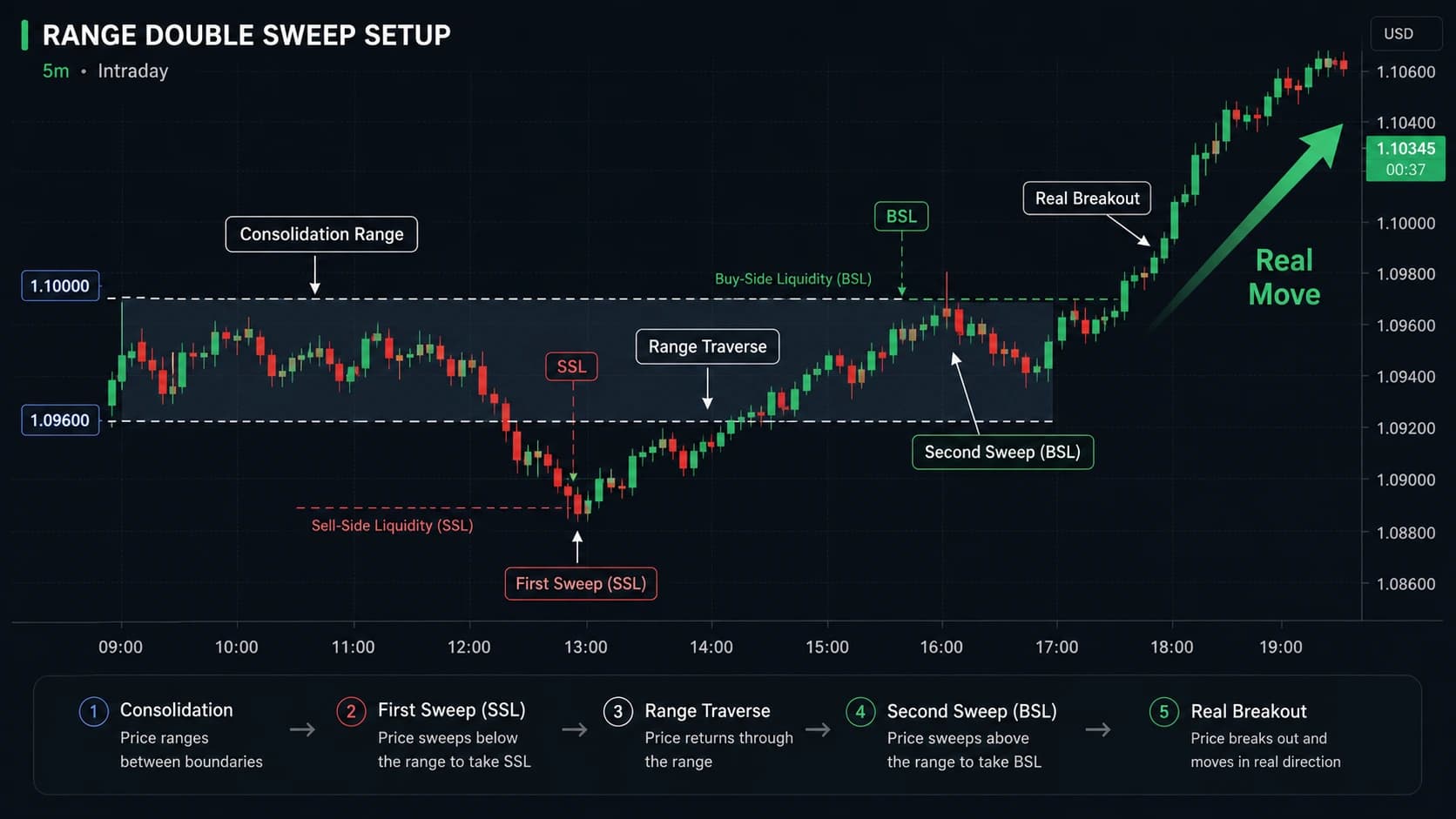
Premium/discount zones tell you where price will go after a liquidity sweep. The sweep collects the orders needed for institutional positioning; the premium/discount zone identifies where that repositioned price move will begin from.
The ideal sequence:
- Price is in the daily discount zone
- A sell-side liquidity sweep occurs just below the discount zone's edge (sweeping SSL)
- Price snaps back into the discount zone
- Entry at the OB or FVG in the discount zone
- Target: the premium zone above
Connection to Order Blocks
Order blocks without premium/discount context are incomplete. A bullish OB in the premium zone has low probability — institutions are selling at premium, not adding to longs. The same bullish OB in the discount zone has high probability.
The OB filter: Before entering any order block, classify it as either:
- In the correct zone (bullish OB in discount, bearish OB in premium): Grade eligible
- In equilibrium: Grade reduced
- In the wrong zone (bullish OB in premium, bearish OB in discount): Grade disqualified
Connection to Fair Value Gaps
The FVG quality hierarchy with premium/discount:
| FVG Position | Quality |
|---|---|
| Bullish FVG in OTE zone (62–79% discount) | A+ |
| Bullish FVG in deep discount (below 50%, above 62%) | A |
| Bullish FVG at equilibrium | B |
| Bullish FVG in premium zone | C or invalid |
Part 7: Applying Premium and Discount to Stocks — Specific Considerations
Choosing the Correct Dealing Range for Stocks
For US stocks, the following dealing ranges are most consistently reliable:
- Daily dealing range: From the most recent daily swing low to the most recent daily swing high — the primary dealing range for swing traders
- Intraday dealing range: From the prior day's low to the prior day's high
- Weekly dealing range: For position traders
VWAP as a Dynamic Equilibrium Reference
For US stock day traders, the Volume-Weighted Average Price (VWAP) provides a dynamic, real-time equilibrium reference that complements the Fibonacci static equilibrium.
The VWAP + Fibonacci dual filter:
- A bullish OB or FVG that sits both below the Fibonacci equilibrium (50%) AND below VWAP = maximum discount confirmation
- A bearish OB or FVG that sits both above the Fibonacci equilibrium AND above VWAP = maximum premium confirmation
Sector and Index Premium/Discount Alignment
The three-tier alignment rule: For maximum conviction trades, require that the individual stock, its sector ETF, and the index are all in the same premium/discount zone. If even one is misaligned, reduce position size by 50% and treat the setup as Grade B.
Part 8: The Complete Premium/Discount Analysis Process
Pre-Market Analysis — Step by Step
Step 1 — Weekly Chart (2 minutes): Draw a Fibonacci from the most recent significant weekly swing low to the most recent swing high. Note whether current price is in weekly premium, equilibrium, or discount.
Step 2 — Daily Chart (5 minutes): Draw a Fibonacci on the most recent daily BOS range. Mark the 50% equilibrium and the OTE zone (62–79%). Identify any PD arrays in the OTE zone.
Step 3 — 4-Hour Chart (5 minutes): Find 4-hour FVGs that overlap with valid order blocks and sit in the correct premium/discount zone.
Step 4 — Filter your setups: Only proceed with setups where the PD array is in the correct zone at the daily timeframe and the daily and weekly zones agree in direction.
Session Execution — Zone-Based Decisions
When price approaches your zone and the alert fires:
- Switch to the 15-minute chart
- Identify the micro dealing range within the 4-hour zone
- Find any 15-minute PD arrays in the 15-minute discount (for bullish setups)
- Wait for the 15-minute CHoCH
- Enter on the CHoCH confirmation
Part 9: Common Premium and Discount Zone Mistakes and Exact Fixes
Mistake 1 — Using Random Swings to Define the Dealing Range
The fix: Before drawing any Fibonacci, confirm that at least one end of the range was created by a structural BOS or CHoCH. Random wicks and minor internal swings are not valid dealing range boundaries.
Mistake 2 — Entering at Equilibrium
The fix: Only enter at premium (for shorts) or discount (for longs). If you feel compelled to enter at 50%, that is FOMO, not analysis.
Mistake 3 — Ignoring Multi-Timeframe Zone Alignment
The fix: Before entering any discount or premium zone trade, confirm the direction on at least two higher timeframes. If the weekly is in premium while you're buying the daily discount, your trade is counter-institutional at the highest level.
Mistake 4 — Trading Premium Zone Longs or Discount Zone Shorts
The fix: No matter how strong the trend, do not enter long at premium or short at discount. This is the rule — not a guideline.

Mistake 5 — Not Accounting for the OTE Zone
The fix: Always try to enter at the OTE zone (62–79% retracement). A missed trade at poor risk-reward is preferable to a forced entry at shallow discount.
Mistake 6 — Changing the Dealing Range Mid-Trade
The fix: Define the dealing range before entering. Once in the trade, the dealing range is fixed. Redrawing the range to justify staying in a losing position is rationalization, not analysis.
Mistake 7 — Applying Premium/Discount to Ranging Markets
The fix: Premium and discount zones are only valid when the dealing range is defined by a structural BOS or CHoCH. In a ranging market without meaningful BOS moves, wait for a BOS out of the range before drawing the new dealing range.
FAQ
Q: What is the premium and discount zone in SMC trading? Premium and discount zones divide any price range into two halves using the 50% Fibonacci equilibrium level as the dividing line. Everything above 50% is the premium zone — where price is institutionally expensive and selling is preferred. Everything below 50% is the discount zone — where price is institutionally cheap and buying is preferred.
Q: How do I draw premium and discount zones? Use the Fibonacci retracement tool. For a bullish setup (uptrend), draw from the most significant recent swing low to the most significant recent swing high — both ends should be defined by structural events (BOS or CHoCH). The 50% level marks equilibrium. Everything below 50% is discount (buy zone). Everything above 50% is premium (sell zone).
Q: What is the Optimal Trade Entry (OTE) in ICT trading? The OTE is the highest-probability entry zone within the premium or discount area. It sits between the 62% and 79% Fibonacci retracement levels, with the 70.5% level as the precise sweet spot. The OTE provides the best risk-reward of any entry location because the entry is deepest into the favorable zone while still above the structural invalidation point.
Q: Can I buy in the premium zone if the trend is strong? Technically price can continue rising from premium in strong uptrends, but entering long at premium means buying at institutionally expensive prices. The consistent, disciplined approach is to only buy in discount and only sell in premium — period.
Q: What is the difference between equilibrium and the OTE zone? Equilibrium (50%) marks the boundary between premium and discount — fair value. It is not an entry zone. The OTE zone (62–79%) is within the discount half of the range (for bullish setups) and represents the deepest, most institutionally favorable entry level. Equilibrium is a reference point; OTE is the precision entry zone.
Conclusion
Premium and discount zones are the foundational positioning framework of Smart Money Concepts. They answer the question that every other SMC tool cannot answer alone: Is this a good price to enter right now?
The three principles that matter most:
1. Only buy in discount, only sell in premium. This is the rule. Not a guideline. Every trade that violates it carries counter-institutional logic regardless of how compelling the setup looks.
2. The OTE zone is your precision tool within the zone. Wait for price to reach the 62–79% OTE zone. The extra patience produces dramatically better risk-reward and filters out the shallow entries that reverse before reaching targets.
3. Multi-timeframe zone alignment multiplies probability. When the weekly, daily, and 4-hour dealing ranges all point to the same premium or discount position at the same price area, you have institutional alignment across three independent timeframes.
Related Articles
- Smart Money Concepts: The Complete Mastery Guide — The full SMC framework that explains where premium/discount zones fit in institutional trading logic
- SMC Market Structure: BOS, CHoCH and Strong vs Weak Levels — The structural events (BOS and CHoCH) that define the dealing range you use to measure premium and discount
- Order Blocks: The Complete Mastery Guide — How to grade an order block's quality based on whether it sits in the correct premium or discount zone
- Fair Value Gaps: The Complete Mastery Guide — FVG probability is heavily influenced by its position within the premium or discount zone
- Liquidity Sweeps: The Complete Mastery Guide — How sweeps into discount (or premium) zones create the highest-quality entry conditions
- Accumulation, Manipulation, Distribution (AMD Cycle) — The Judas Swing typically drives price into the discount or premium zone before the real directional move begins
Disclaimer: This article is for educational purposes only and does not constitute financial or investment advice. Stock trading involves significant risk of loss. Past performance of any trading strategy does not guarantee future results. Always use proper risk management and only trade with capital you can afford to lose.
Continue Reading